









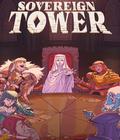
 Sovereign Tower is an Arthurian-inspired Round Table management RPG with some Monty Python-esque humor thrown in for good measure.
If you were asked to picture how a serious monarch simulator would play out, you might imagine something that would seem daunting to play for some people: an interface filled with all sorts of minutiae for strategy buffs, a storyline that is based on historical events or tries to emulate them, and a serious edge. Sovereign Tower has some of those traits, but the edges have been softened to feel accessible to a broader audience with an open mind. We recently played a short preview build for the game and came away both intrigued by what we played and teased by what we couldn't try yet.
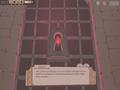
The story is a light send-up of the Arthurian legend. You play as a wandering leper who has stumbled upon a tower. That tower has a key in the lock that will grant the title of "Sovereign" to the one who's able to open the lock. Others have tried and failed, but you open the lock with ease. You are now the sovereign of the land, so you need to build a Round Table full of knights to serve anyone who needs your help or deal with anyone who tries to oppose you.
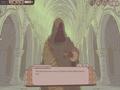
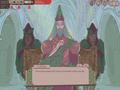
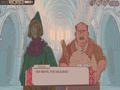
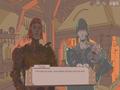
The idea of re-imagining the King Arthur stories with offbeat twists continues with the characters. You have knights who fill the expected archetypes, from the noble and dimwitted to the overly posh ones who are in it for the fame. You also have ones who feel new, such as a knight who's scared of ghosts or revels in the macabre. This also extends to some of the subjects you meet, such as a farmer with a goat that looks like it wants to murder you or a noble with attendants who add unnecessary flourish to everything being said. This isn't a game that goes for all-out laughs with easy jokes, but it has little moments of absurdity to ensure that it isn't a completely serious affair.
The game is a mostly menu-based affair with loads of visual novel-type scenes. It is governed by a time-of-day system that isn't as rigid as expected. You start each day with the choice of hearing from audience requests, upgrading the castle with new rooms, repairing or buying items to strengthen your knights, or listening to your staff or knights for gossip or more insight on their characters. You can do these things in any order you wish, since you have no time limit. If you take an audience, you'll listen to their requests about things like figuring out which animal has been terrorizing the village, stopping a cult from blessing the flour, and holding a festival to drive up tourism. Some of the requests are solved easily through dialog and action choices, while others are bigger and require the help of knights to fulfill them. No matter the request, each one is affected by or affects your standing in a few key areas, such as approval with the people or the aristocracy. Your decisions also shape the kind of ruler you'd be, such as wise or kind or merciless; this also affects future choices. This section is simple enough to operate; there are clear indicators of what's affected with each choice, but until the decision is locked in, there is no indication of how strong the impact will be.
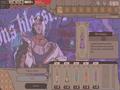
Once you take in all of the day's requests, you proceed to the Round Table room to dole out quests assignments to the knights. Each quest has some visible traits, and it falls on you to match up the knight with the appropriate quest. However, there are more than stats at play; you have to look at each knight's personality to see if the quest fits them. Depending on what you do, you can either match people with their interests or order them to do something they hate, which reduces their standing with you from a friendship or perhaps romantic level.

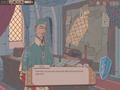
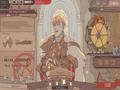
Once everything has been doled out, you proceed to the next day, when the knights return with results. The results almost feel like a dice roll in terms of success or failure and their various levels; stat-matching knights with quests is never guaranteed, but the game keeps things interesting with some unexpected outcomes. For example, one quest has you trying to get rid of a goose from a bathhouse only to lead to the revelation that the goose has a nest there and the people are pampering her. This again solidifies the game's status of being lightly humorous and encourages you to experiment with knight and quest combinations.
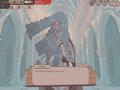
While all of this sounds whimsical, there are dire consequences that come from bad decisions and outcomes. Alliances will break down. People will rebel. Knights will die. Eventually, the game throws challenges at you that need to be overcome, or else the game ends. One such encounter in the preview build involved a dragon knight who challenged you to find allies and have your knights best him in combat — or else you're uncovered as a false monarch. We failed this challenge and were thrown into the tower dungeon.
The most intriguing thing about the game occurs when you face defeat. You meet with the spirit of a demon that claims to be part of the tower, and while they delight in your defeat, they also offer you the opportunity to go back in time to replay sections of the game in the hopes of a different outcome. Usually, this kind of thing doesn't happen in a strategy title like this. The only way to replay a segment is to reload from a previous save before it gets overwritten or simply start over with a new game. Unfortunately, the preview build ends once your conversation with the demon ends, so there's no telling how all of this will work.
We're really curious about how Sovereign Tower will turn out, and it's all because of that tower demon. Their exact powers, functions and limitations will be a big factor when it comes to the freedom you can have in your reign and the replayability of the game. Aside from this, the rest of the game does what it set out to do quite well. The semi-eccentric characters have subtle senses of humor. The game mechanics are easy to understand but require some thought to execute. The stat management is enough to provide some depth for those who are familiar with the genre. There's no definitive release date for Sovereign Tower yet, but we are looking forward to seeing how the game evolves.


More articles about Sovereign Tower