



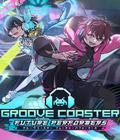
 In Groove Coaster: Future Performers, you race along rails in sync with the music, enjoying thrilling gameplay and an immersive experience enhanced by dynamic lighting and visual effects.
Unless you live near an arcade that specializes in unique rhythm game offerings from Japan, your first exposure to Taito's Groove Coaster is likely to be either the PC version released in 2018 or the Nintendo Switch iteration subtitled Wai Wai Party that was released a year later. That last game was perhaps the best way to play the series, since it had support for DLC songs that were released from the game's initial 2019 launch up to March 2025. The DLC is coming to an end, so fans of the series finally have a new game with Groove Coaster: Future Performers, and the result is a title that is better in some ways and a bit divisive in others.
For those unfamiliar with the series, the core mechanics follow the blueprint set by countless other rhythm games of the past. You select a song, and then you hit buttons to match the song's beat whenever the note in question hits your avatar until said song ends. You pass if you can hit the beat just right for about 70% of the song, while your score is determined by how many beats you hit and how close you are to getting the beats hit at the perfect time.
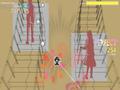

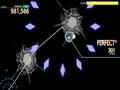

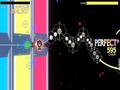
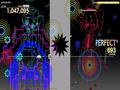
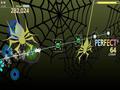
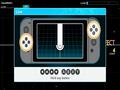
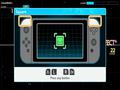
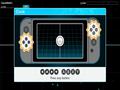
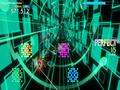
That's where the similarities end; almost everything else in Future Performers is different from what you'd see in other rhythm titles. The notes follow a path that tries to emulate a roller coaster, so the path goes up and down and in circles. It can feel similar to any of the Hatsune Miku rhythm games from Sega or the big indie PC game Osu!, but there's a visible path and the use of 3D, since the path goes in and out of the screen's viewpoint. There are several different notes in the game, but they're designated as note types since nothing is relegated to a specific button. For example, regular notes can be hit with any of the face buttons or any of the d-pad directions, and the only time that a specific direction is needed is when the note is represented by an arrow. Square notes can be hit with any of the shoulder buttons or triggers. Hold notes take on the same properties, and there are moments when you may be asked to hold a note while also hitting a few other notes.
The looser note restrictions make the game easier to come to grips with when compared to other rhythm games. You can hand this game to someone who isn't too familiar with the Switch's control scheme or someone who gets the layouts mixed up with other console controllers, and they'll still have some success since there's a decreased chance of hitting the wrong button. The visible line also provides players with some guidance about where they need to focus instead of darting around the screen. Genre veterans can make the game tougher with variable difficulty levels, but those who aren't so adept at the genre can enjoy themselves without feeling like the game has been "dumbed down" too much.
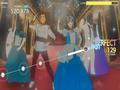
At the same time, the design decisions to make the game more accessible can be undone because there are many other distracting elements on-screen at the same time. Every song comes with a specific video playing in the background, so there's always something moving to catch your attention. Each note you hit also comes with an extra bit of flourish. It can almost be a stimulus overload, especially when combined with the movements of the note track.
Those who have played older entries in the series will notice that a few things from the older games have gone missing. Scratch notes are gone, but their removal means that you can concentrate on pure button action rather than messing around with the analog sticks. The more divisive choice is the removal of ad-lib notes. These were notes that were hidden in each song, and the game never told you about them. They were notes that you'd find by messing around at the right time. For those who love experimental play, they were neat additions, but some high score chasers hated having those hidden notes be instrumental in reaching the highest score. Their removal evens the playing field between all players, but it is something to note if you were a veteran of the series and hoping to faff around and look for secrets.




Another issue for series veterans is the soundtrack. To be fair, the soundtrack contains a mix of songs that are similar to what the series had before. The soundtrack consists of original electronic songs by Japanese artists, remixes of familiar Taito themes, some vocaloid and Touhou-related tracks, and a smattering of anime themes. Just about everything listed is brand new to the series. The tracks are also very good, but there are only a small number of songs: 53. It's still a good number for a rhythm game, but when compared to the 110 available in Wai Wai Party, it's a letdown to have half the number of songs. Just like the previous game, DLC is already being released to fill up the song list, but that encourages players to wait for a good sale to lessen the financial hit.
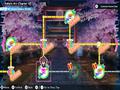
Future Performers is split into two main modes, with Freeplay returning from the previous title with no changes. The main mode that people will play is Story mode because it contains all of the song and character unlocks. The mode is long, but it has some issues that make it a chore. First, a good chunk of the mode is filled with visual novel-style cut scenes with characters that are very one dimensional. You can easily identify each person's typical personality from just one sentence. The scenes run rather long, with some uninteresting and stereotypical dialogue. Every scene can be skipped, so you don't have to mash the A button. Secondly, the campaign length and the smaller soundtrack mean that you'll be forced to play through the same songs multiple times until the end credits roll. With no changes to the songs and the challenges being quite easy, the repetition can make the mode feel like a chore. Finally, the mode feels somewhat incomplete since there are reminders about how DLC will provide more content.
Groove Coaster: Future Performers is still a solid entry in the rhythm game series. The base game mechanics provide a fun rhythm game experience for a wide variety of skill levels — if you won't feel overwhelmed by the visuals. The soundtrack remains excellent, as always. The smaller song selection is disappointing, while the main story mode is fine if you can power through an uninteresting tale. Series veterans may come away a little underwhelmed, but newcomers may find this to be an enjoyable first entry before diving into the older but ultimately deeper Groove Coaster: Wai Wai Party.
Score: 7.0/10



More articles about Groove Coaster Future Performers