









 Bask in the crimson-red catharsis of ultra-violent "bloody action" and dive into a completely unpredictable story.
Killer is Dead, Let It Die, Lollipop Chainsaw, and Michigan: Report from Hell are just a few games from designer Goichi Suda (better known as Suda51) and his team at Grasshopper Manufacture. The polish of each title can vary wildly, but all of their games feel distinct. Either the setup is strange, the constant gameplay and presentations catch you off guard, or some elements come out of left field. Nothing in those titles makes you think that you're getting something familiar. That same kind of energy is present in Suda's latest game, Romeo Is a Dead Man.
The story is both convoluted and a bit gonzo, as it takes roughly four introductory sequences before you understand what's going on. Years ago, an incident occurred that would've destroyed the Earth and its inhabitants. Instead, a fractured universe formed where everyone had an alternate version of themselves. Players take on the role of Romeo Stargazer, a rookie deputy who is into conspiracies and the occult, and he plans to leave the town of Deadford. While Romeo's on patrol with his boss, they stop to check on a creature lying in the middle of the road. The creature proceeds to tear them apart. Romeo is on the verge of death, but his grandfather appears and saves Romeo's life by injecting him with a nanite-infused serum. That serum causes Romeo to become a living dead man, complete with a robotic arm, sword, and a life-saving helmet. Through a flashback, you learn that Romeo saved a person named Juliet, who was also lying on the side of the road. The duo planned to leave town together before she disappeared. In the present day, you discover that Romeo's grandfather's act of saving his grandson cost him his life, but the grandfather's essence has transferred over to the large patch on the back of Romeo's jacket. You also discover that Romeo has been recruited to join the FBI's Space-Time Police division to hunt down criminals who have been causing mayhem while hopping between the fractured universes. One of those criminals happens to be Juliet.

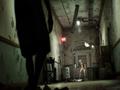


The setup is strange, and the quirkiness doesn't let up in the narrative department. Your cast of characters includes a talking cat; people who only communicate through monitors; and your mom and sister, who are somehow permitted to be in the FBI headquarters with you. Some characters are there to spout philosophical monologues, while other scenes simply amuse and have no connection to the tale. The game conveys its story through field notes, stop-motion video scenes, fully animated scenes, in-game cut scenes, and comic books. The game loves to do time jumps, and each major mission is set up like an anime complete with mid-episode breaks, a quick end-credits sequence, and parody covers of The Clash's London Calling album art. The storytelling and its methods are seemingly all over the place, but it's part of Grasshopper Manufacture's charm.
The combat system is reminiscent of the studio's older titles. Maneuverability is basic; you can run and jump, but not very high. You can perform a basic dodge that quickly becomes a dodge, followed up by a roll. You need to wait until you're further into the game before you can add an air dodge into the arsenal. You start with a basic sword for melee attacks, but later, you can use metal fists, a larger sword that acts more like a club, or a spear that can be broken into two pieces for dual-wielding action. You also have projectile attacks; you start with a pistol and later on, you can access a shotgun, machine gun, and rocket launcher. All of your guns need to be reloaded, but you have infinite ammo. Using any of your weapons fills up a blood meter which, when full, lets you unleash a more powerful strike that also refills some health.
The combat has some interesting and quirky features. All of the bosses and most of the bigger enemies sport weak spots, but boosted damage from those spots only occurs if you hit them with projectile weapons. The save spots act like fireplaces in Dark Souls, where you can refill everything you have, but all previously defeated enemies (minus the actual ambushes) will respawn. Dying causes you to participate in a game of roulette, where you can return with some temporary buffs, a trait shared by the items you pick up. Encountering some enemies will give you certain ailments, and while you can wait for the effects to go away, you can also get rid of them with pills or a button sequence that must be initiated in the middle of a fight. Compared to everything else offered in the game, it's pretty tame.
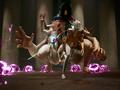



For the most part, the fighting feels right except for two specific things. The first is the lock-on system, which is functional but not something you'll employ in anything outside of boss fights. The system has a tendency to lock onto the enemy farthest from you instead of more immediate threats, and with you fighting against multiple enemies at a time in some not-so-open spaces, you'll tend to avoid the lock-on system. The second element of the combat that doesn't hit very well is the overwhelming amount of gore. There's nothing grotesque about it, and the gratuitous blood splatter is generally welcome, but the amount shown at one time tends to have the knock-on effect of obscuring the screen. Unless you learn to always perform a dodge after a few hits, the amount of blood showering the screen means that you won't see a stray hit coming your way. That happens quite often, considering how you're almost always fighting multiple enemies at a time.
The missions follow a loop that matches the odd game narrative. You start in a level that's set during a specific time period. The levels are set in specific places, like a cult compound or city hall or an asylum, and the only hint about the time period (aside from the title screen that explicitly tells you the year) is the style of clothes that some of the monsters wear. While you're roaming around the environment, you'll run across TVs that warp you into a void known as subspace, where you'll need to find parts of a key and another TV that takes you to a different part of the level in what they call "real space." You go through this cycle multiple times until you assemble all of the key pieces, which brings you to a gate that transports you to a boss area for the big fight.
Initially, the gameplay loop seems pretty straightforward, and all of the stages revolve around this mechanic. However, each stage adds its own twists to keep things interesting. For example, the mall is a big open space that asks you to start generators to power up the place. City hall asks you to find safe combinations and mystical keys to break down barriers. The asylum changes things wildly, as it takes away access to your weapons for a short while and transforms the game into a sneaking survival/horror title. The changes to the flow aren't jarringly drastic, but they're enough to keep the experience feeling fresh despite the repetition of the gameplay loop.
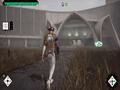
It doesn't feel like a Grasshopper Manufacture title without some kind of big gameplay twist, and that happens when you're outside of a mission. It starts with the Last Night, the FBI ship that you call your base and home. You navigate the whole ship using a top-down 2D perspective instead of a behind-the-back 3D view. The graphics also go for a completely sprite-based look instead of a polygonal one, while the dialogue only has voice snippets instead of being fully voiced. You can talk to a number of people to get their backstories. Talking to the nurse gives you something akin to a personality quiz with no real benefits, aside from just doing it for fun.




There are three important people you'll talk to often aside from the game's mission givers. The first person is your mom. During battles, you'll collect different ingredients like potatoes and chicken and various spices, all of which are used to make katsu curry recipes. Like the other items you get in the field, the curry is responsible for giving you temporary buffs, and while the process of making this is fairly automatic, you are responsible for frying the katsu pieces via a cooking minigame where you need to time when to pull the katsu from the oil. The grade of the katsu frying affects the item benefits, and while the minigame isn't that easy to master, its appearance falls in line with the studio's desire to add as many disparate things as possible to its titles.
The second person is your kid sister, who runs a garden responsible for growing Bastards, which are zombies that have been transformed into weapons. Like the katsu curry ingredients, you gather up Bastard seeds on the battlefield, but you need to get your sister to identify them before planting them. After waiting for them to sprout, you can use each Bastard as a weapon in a fight, since they can do things like pop up a healing area, shoot lasers in all directions, shoot poison, or become suicide bombers. The Bastards can be used an infinite number of times if you can wait for their cooldown timer to expire, but they can also be powered up by having two of any type combine to produce a new seed that immediately sprouts when planted. You aren't going to be able to create a hybrid Bastard this way, such as one that shoots lasers while also producing more seeds on the field, but the ability to craft more powerful Bastards becomes an addicting exercise, especially since they are infinitely useful in any fight.
Finally, there's the FBI Space-Time mascot, who is your means of upgrading most things in the game. He has four machines in his office, with one dedicated to unlocking all of the projectile and melee weapons. Since you'll have enough funds before the first major boss fight to unlock everything, you'll visit this machine the least. The next machine allows you to upgrade your weapons using a material called Sentrey that you'll collect on the battlefield. One machine also lets you convert your space junk into Sentrey, and while both machines have cool motifs, both are also pretty straightforward to use. The final machine lets you upgrade Romeo, and this is much more interesting to use because it is designed as a top-down maze racing game. Another material known as Emerald Flowsion is used as fuel, and you drive your car around the maze and collect icons that correspond with things like health and attack power and number of health packs you can carry. You can re-spec upgrades if you take an unintended turn, but the overall upgrade process is so strangely appealing that you might re-spec just to see all of the maze's paths. Unlike all of the other facilities on the ship, this one is accessible directly from the game's save point, so there's no need to teleport back to the ship, especially if you're planning to use the save points to farm upgrade materials.



To a lesser degree, the journey from locating a new level to traveling to one is also fascinating because of its approach. You first need to find the dimensional rift, and that's done by playing a version of Pong with an odd control scheme; the goal is to guide the ball into the goal at the center of the screen. From there, you select the rift you want to traverse and manually fly there while moving a cursor to collect items that are floating in space. The whole process isn't as involved when compared to your activities on the ship, but it's still interesting to mess around with.
Outside of the main mission, there are several other elements in Romeo Is a Dead Man that help you level up and extend your time with the title. The game has several portals that take you to Palace Athena, which are procedurally generated dungeons of various difficulty levels that earn exclusive badges alongside upgrade items, like Emerald Flowsion and Sentrey. There's also an area in the ship where you can replay boss fights, but it's riskier compared to other games, since you have to pay a fee to participate. The only way to get your money back is to survive the fight; beating the boss under the given par time gives you bonuses on top of what you bet. Finally, beating the game once allows you to unlock a higher difficulty level if you are itching for a replay in New Game+ mode.
Graphically, Romeo Is a Dead Man features the usual look of almost every other Grasshopper Manufacture game before it. The models look nice and animate fairly well, but don't expect to get a ton of visible details unless you're viewing an in-game cut scene. The environments look fine, but there's no visible texture detail pop-in or any pop-in of any sort. The frame rate is solid, provided you have a high-end video card; lower-end stuff works fine if you really lower the settings. The whole thing looks great, but the only issue is that the colors look completely washed out in every scene.
That said, there are some graphical issues that plague the game. Some cut scenes have ghosting whenever some characters are placed against harsh light sources. The performance drops significantly whenever you're placed into the busier areas of subspace. There's also a bug where warping from a save point to the Last Night ship and warping back into the mission battlefield causes the frame rate to significantly drop until you either reboot the game or have the game go into multiple 2D cut scenes to reset the issue. To be fair, the game has been patched multiple times during our review period, and there's a good chance that these things will get patched out by the game's official launch. It's something to be aware of in case a day-one patch doesn't arrive.

The developer's games have always had great audio, and Romeo Is a Dead Man continues with that tradition. The voice work is solid, and the cast does a great job of delivering the dialogue with a level of seriousness despite the absurdity of some of the lines. The effects are appropriately punchy with no drops heard whenever too many things are happening in the soundscape. The music ranges wildly from eerie to adventurous and high tempo to licensed material for boss fights; the accompanying audio does a great job of making the fights feel more epic than usual. This is excellent all around, and it deserves to be played at audible volumes.
If you plan on playing Romeo Is a Dead Man on a Linux machine, you'll be happy to know that the game runs right out of the box with the latest version of Proton enabled. If you plan on playing the game on the Steam Deck, you'll need to do a bit of tweaking to get the playability to an acceptable level. While the game defaults to 1280x720, the settings from your main PC will transfer over, so you'll need to use the Low graphical preset if you want to play the game on this device without using FSR or XeSS. Doing that will have the game run at a little over 30fps most of the time, with drops to around 20fps whenever there's too much happening on-screen at a time. Because of how heavy the game is, expect around 90 minutes of game time on a full battery charge if you're using the LCD version of the Deck.
Romeo Is a Dead Man really is made for fans of Grasshopper Manufacture. The story is bonkers but not confusing. The gameplay is solid, but it has plenty of elements that give the game an overall sense of strangeness and character. Its presentation may not be the strongest, but it is also unique enough considering that the game uses a very popular engine. Romeo isn't quite a game for everyone, but the game will pique your interest if you're an action fan looking for something that's slightly off the beaten path.
Score: 8.0/10
More articles about Romeo Is A Dead Man