







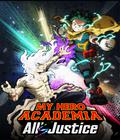
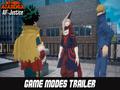
 My Hero Academia: All's Justice invites players to experience “One Last Smash” through a cinematic story mode and action-packed 3v3 battles that showcase the series’ most iconic Heroes and Villains in their final and most powerful forms.
My Hero One's Justice represents the fighting game interpretation of the My Hero Academia manga and anime series, and its reception has met expectations. It is a more casual fighting game that prides itself on delivering spectacle and a low learning curve over competitive balance. It's a game strictly for the fans and is a generally fun experience if you're willing to accept the title for what it is. The first two games were released in quick succession, with the original releasing in 2018 and the follow-up arriving in 2020. The six-year wait for the latest game, My Hero Academia: All's Justice, has been unexpected, leading to the expectation that some significant changes have been introduced to warrant such a long time between titles. There have been some big changes to the game, but not all of the changes are positive.
All's Justice starts off very differently when compared to the previous titles in the series and anime fighting games in general. Get past the title screen, and you have no menus to navigate through the different modes. Instead, you're immediately thrown into a fight where you control a fully powered-up version of Izuku Midoriya against Tomura Shigaraki, who's been infused with All For One's powers. The fight acts as a light tutorial for the fighting system, and finishing the fight takes you to a montage of all characters before you're whisked off to a town plaza. From there, you need to find All Might and go through a tutorial on navigating the space before the game menus are finally available.

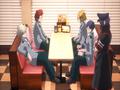
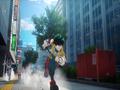

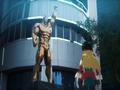
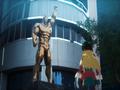
At first glance, the town plaza seems like a combination of a graphical online lobby seen in many Arc System Works games, with the look of the city in Street Fighter 6's World Tour mode. The plaza has loads of NPCs milling around and holding short conversations with one another. You'll also catch a few proper characters doing the same, but the only ones you can talk to are ones that are in charge of the various modes. Things open up as you play a few other modes, since you can talk to people and get into random fights or get roped into quick side-quests for rewards. The plaza is gated off with invisible barriers, which make the area feel more restrictive since the barriers appear in places that should be easily navigable, such as alleyways and stairs and roads. The idea is neat, but you'll be very glad that there's an option to navigate through the modes more traditionally using your in-game phone.
The game has a number of modes available, but the multiplayer ones seem to have minimal changes. The local versus mode lets you change the CPU difficulty during match setup instead of at the character select screen. Online versus matches give you a practice space while you're searching for real matches. Otherwise, the modes are the same as before.
There have been significant changes in the single-player modes. Story mode makes a return with a focus on the final conflict between the heroes and villains. There are some scenes that are fully animated with a combination of anime scenes and in-game re-creations of pivotal moments. There are scenes that are composed of static shots with artificial panning and zooming and a few other shots that are sets of stills stitched together in a way that resembles animation, minus any real smoothness. Combined with the fact that some fights are filled with continuous rambling from all characters from beginning to end, and you have a mode that continues the series tradition of appealing to die-hard fans who aren't very discerning.
Mission mode from the past games has evolved into Team-Up Mission mode, and this is where the single-player game is beefed up. You'll go through several different versions of the plaza, giving you a somewhat open-world feeling where the world is divided into smaller sections. The sections are still heavily populated with NPCs and heroes, some of whom offer side-quests or even a few side-fights. You'll go through missions with a persistent health bar, but you can visit stores and hotels to replenish that meter. You can also get your fellow students as sidekicks, and their benefits are more expanded. Not only can you use them as partners in a fight, but you can also have them automatically take care of some minor side-quests. Their movement abilities also come in handy for accessing otherwise hard-to-reach areas. For example, switching control to Ochaco Uraraka means you can use your anti-gravity ability to float higher or use Shoto Todoroki's ability to use ice for gliding around.
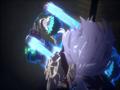




This is the mode where most players will spend their non-multiplayer time with All's Justice, and for good reason. The move to a semi-open world setting versus a series of menus makes the game feel vastly different from most other anime-based games. Even though the city isn't fully interactive, the setting makes the game feel like you're living out a big part of the show that is rarely covered in most games. The traversal acts as a good break from the fighting, and the more lighthearted elements make the mode feel fun. Even if you aren't a big fan of the anime, the mode is worth experiencing.
Character Memory is an interesting mode that requires you to finish Team-Up Mission mode, so you have all of the sidekicks available to get the most out of the mode. Like Team-Up Mission mode, the stories are more "slice-of-life" themed, with a good mix of battling and exploration missions. Each of the 20 characters has their own set of missions, and that's why you should finish Team-Up Mission mode first, so all of the missions are unlocked. This is more of a bonus mode rather than something you'll need to focus on, but the mode is light enough to be a very good diversion.
Archive Battle mode is another mode that requires significant progress in a different mode — this time it's Character Memory — to make real progress. What's different is that the focus is on some significant battles that have occurred prior to the final story arc in this game, so you'll always have your preset teams to work with and an added goal of finishing each fight as quickly as possible. Finishing each fight lets you replay the fight with any character you want, but that's something very few players will try because there's no benefit for deviating from the default.
Tying together all of the modes are the unlocks, and just like in the older games, there are plenty of them available. You have alternate costume and colorway unlocks for every fighter on the roster. You can get new visual emotes for them for use in multiplayer chat. There are also several cosmetic changes for the game HUD, but you might skip on some of those since the stickers provide no information and just make the screen look cluttered. The main complaint has been present since the start of the series, and it's that there are barely any new fighters or stages to unlock. Any new fighters are obtained through DLC purchases, and unlocks seem to be for aesthetics rather than expanding the gameplay experience.
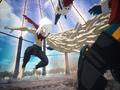




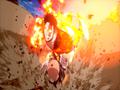

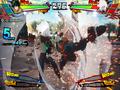
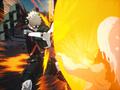
The fighting mechanics have gone largely unchanged compared to the previous entries in the series. The combat still relies on the three-button system, with a basic attack and two quirk-related ones that counter each other in a rock-paper-scissors style. While the fighter balancing is questionable, the overall count has increased to over 60 fighters before character unlocks and DLC. All of them play differently enough from their previous appearances in earlier games, since this is all about the characters in their final forms. Characters like Izuku will need to be re-learned due to the number of new moves he has, even in the basic combos.
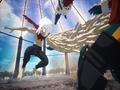
There have been some changes to the core fighting mechanics, which will be very noticeable to longtime players. The biggest change is the move to a true 3v3 fighting system versus one with a main fighter and two sidekicks. If you wanted to use other games as a comparison point, you can look at the first two games as a non-tag version of Marvel vs. Capcom, while this entry is more like Marvel vs. Capcom 2. Having your partners become playable fighters requires more thought in the team selection. You aren't only concerned about their special moves, and the fights aren't that much longer, since there's only one round. For an anime that emphasizes hero teams, this change has been a long time coming.
The other change is an expansion to the simple control method introduced in the previous game via a patch. Like many modern fighting games, the simpler control method is meant to ease fighting game newcomers into the genre by allowing them to mash one button to pull off some combos and special moves. Due to the nature of All's Justice, the simple mode also means that the game will let you do character switches when the time is right. You can also unleash the bigger special moves at the end of combo strings. That can feel like too much simplification for some, but at least you can turn off the use of one button for the big special moves and character switching. For a game that's already considered for casual rather than serious competitive play, this new control scheme fits in just fine.
Despite the positive changes and improvements the fighting system has seen, one change feels like a regression, and it has to do with the arenas you fight in. That might not seem like a big deal in most other fighting games, but the environments play a more important role, since there's a level of interactivity. That's no longer the case in All's Justice, as barely anything can be destroyed. You can't walk up walls like you used to, either, and the space seems so small since it doesn't take long before you encounter the white force field that keeps the fighters contained in the area. There are only nine arenas to fight in, and almost all of them are similar in that they're barren pieces of land or rubble-filled environments. You'll constantly have to jump over the trash strewn around; previously, you could've simply punched the trash out of the way. The more sterile environments take away a good chunk of the spectacle that came from these bouts, which has a knock-on effect of making the previous game from almost six years ago feel more robust.
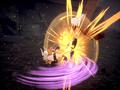



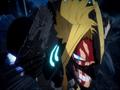
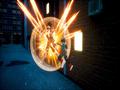
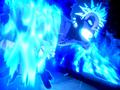
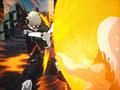
The improvements to the presentation are slight, which is actually good since the previous titles were quite great in this area. Visually, there are barely any changes, but the characters still look great and animate very well. The effects on-screen still have plenty of flourish, and the game doesn't get bogged down once the screen is filled with people and moves. The only noticeable change is with the end of the fight screen, which looks nice with its fade to white. Sound-wise, the music maintains the semi-orchestral vibe of previous games, and it adds some punch to each bout. The game also sports the original voice actors for both the Japanese and English vocal tracks; this had previously only come about in the previous game via a patch. No matter your personal preference, there's nothing to complain about in this area, except for the fact that the title screen audio is always in English, no matter which language you use for gameplay.
If you're playing on a Linux machine, you'll encounter no problems and need no modifications. Steam Deck users playing this game on the handheld will encounter a very mixed experience. The game runs at a 1280x720 but leaves a blurred wallpaper border at the top and bottom of the screen that can't be changed. The game automatically takes on the options made on other devices, so unless you turn everything down to Low settings where applicable, the game will be almost unplayable. Turning everything to Low means that the frame rate fluctuates wildly, as the plaza environment stays capped at 30fps, but it'll have some dips below that. All fighting environments will go from 18fps to 50fps depending on what's happening. Switching fighters means the game looks like a blurry mess before the image stabilizes. All the while, a full charge on the LCD version of the Deck gets you roughly 90 minutes of playtime. Overall, the game is playable, but don't expect a smooth experience.
My Hero Academia: All's Justice is a game where every advancement comes with some regression, locking the game in place rather than moving things forward. The use of fully animated cut scenes is a long time coming, but the inclusion of still shots remains disappointing. The expansion of modes is good, but the presence of a hub world as a replacement for a menu can feel unnecessary. The move to a full 3v3 fighting system is awesome, but the severe reduction of environments and removal of their interactivity robs the game of some spectacle that the series had been known for up to that point. In the end, the game is still good, but it's best as a complementary game to My Hero One's Justice 2 rather than a replacement.
Score: 7.0/10





More articles about My Hero Academia: All's Justice