

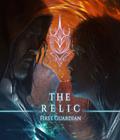

The Relic: First Guardian was released to the public on the PC at the end of July 2026. It was a game that showed some promise, but it was also in a very rough state. The developers kept plugging away at it and released a slew of patches for the game, while also slowly releasing the title across other platforms. It is now the Switch 2's turn to get the game, but those hoping for a massive improvement over the PC version are going to come away disappointed.
The game is set in the world of Arsilthus, where a great calamity has befallen the land. A seal known as The Relic has been shattered, spreading an evil known as The Void across the world. Those who possess the Relic's fragments get overwhelmed and turned into Brutals, powerful humans-turned-monsters with a thirst for killing. You are the First Guardian, a nameless warrior who has been awakened from death by a powerful woman who could be a goddess. Your task is to liberate the shards from the Brutals and reform The Relic to return peace to the beleaguered land.
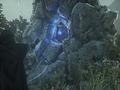
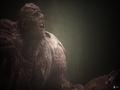
The main story is something that you've seen countless times, and it doesn't help that the game only mentions the key points in passing. This is really noticeable when you don't get an explanation until you defeat the first boss. The real hook from a narrative perspective isn't the main story but all of the side stories during your journey. There are plenty of stories that you'll pick up through notes left behind in the world, and all of those notes are fully voiced. Tales include how a rumor of a golden ax in a pond led to several lumberjacks throwing their own axes into the water, a family trapped in a burning house after refusing to let bandits enter, and an elderly couple trying to hide their son after he transformed into a beast. All of the stories are bleak, which makes the atmosphere feel depressing. That's all too familiar in this genre and can quickly make a player groan. The game always gives you a recap of the stories you collected right after you find the last piece, which is nice if you aren't collecting all of the story pieces consecutively, but it feels redundant otherwise.
As alluded to before, this is a Souls-like game, so genre fans will be familiar with most of the game mechanics. Defense is a big element, since you'll be doing lots of blocking and parrying and dodging, all of which deplete a stamina meter that refills at a decent rate when you aren't performing those actions. Attacks can be done with a number of different weapons, and each has its own skill tree that unlocks new moves, such as an overhead smash or a charged lunge, to name a few. There are special stones that act as both save points and a means to refill your health, and you also gain magical abilities over time to use in your offense.
While all of that may be familiar initially, First Guardian makes several big changes and tweaks to the formula that makes this title feel rather distinct amongst its peers. The first has to do with your offensive moves. Regardless of the weapon you use, swinging it takes no stamina, so you don't have to worry about pacing your attacks to ensure you have enough stamina for a block or a dodge. Using spells also obeys the same principle in that you don't have a mana meter to govern. Instead, you have a cooldown to pay attention to that determines when you can use your magic ability again in a fight.
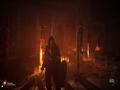
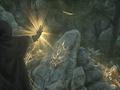
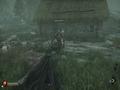
The ability to attack without any penalties already makes the game feel different from its contemporaries, but it doesn't necessarily mean that you can mash the attack button without abandon. You're still at the mercy of attack animations and timing, so blindly mashing away leaves you open to damage because enemy blows hit harder than in other Souls-like titles. You also have normal attacks and a main combo set; heavy attacks aren't available and rob the offense of some variety. Attacking without using stamina may seem like the game should be easier, but that's balanced out by the long cooldown timers for magic spells. Without a mana system, you can only pull off a spell once before waiting a while to use it again. That means using magic is pretty risky unless you're confident in your skills or use it as an opening gambit in a boss fight. In addition, some of the special attacks are even riskier to do, since they require you to use more button presses while not delivering much damage. Again, unless you can pull them off without getting countered, you're better off using normal attacks.
Death is the next change on the list, as it is a tiny bit more forgiving compared to the genre contemporaries. You lose nothing when you die, so there's no dangerous trek back to your death spot to retrieve everything you previously had. The moment you return, you already have all of your previous items, and that can make things a bit less treacherous. The only exception to this rule is with consumables, since using one and dying means you won't get those back. As with spells and special moves, item use is risky, with the exception of your initial healing flasks. One bad break means wasting your goods and trekking back to the merchants to stock up again.
Another big change has to do with the saving stones. One of the hallmarks of the Souls-like genre is that saving is a double-edged sword, as doing so resurrects all of the enemies in the world minus the bosses. That doesn't happen in First Guardian, as all enemies that are killed stay dead, no matter how many times you save. On the one hand, that gets rid of one of the annoying parts of the genre, so you don't have to worry about fighting the same enemies over and over or trying to dodge a gauntlet while hoping you won't get hit before you reach a real trouble spot. On the other hand, those who take advantage of this mechanic to grind and level up lose out on the opportunity to get stronger early on.
Then again, the concept of XP is gone in this game. You can still open up your weapon's skill trees by finding small crystal energy deposits, but there's no XP or leveling for your character. The closest thing is the shards you find in the world; each one gives your character new abilities when you equip them. Some are pretty basic, such as a health gain, while others are more varied, such as a shard that gives you some health for every kill. The idea of using items to achieve something similar to a level-up system is neat, but it means that killing enemies is only good if you want to get gold to buy consumables. It also means that if you're not that good at recognizing patterns and reacting, you'll run into a progress wall more often against bosses. You can no longer use brute force to overwhelm an enemy with updated stats.
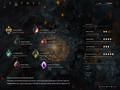
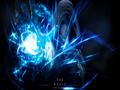
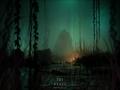
The differences create an interesting Souls-like experience, but the real failings come from the execution of the basics against the bosses, which are a big selling point for the genre. Fights tend to occur in small, enclosed areas with plenty of obstacles to trip you up. There may be fire that you dodge into or debris that you can't see that will interrupt your movement. Combined with the small areas, the camera has a tendency to let walls block your view or bring you into areas where you can't dodge out of, so you'll take several hits that you can't counter, and that can result in cheap deaths. Some items in the area never get reset, so a fight against a mercenary can be easier or harder, since it originally has several explosive and poison barrels in the area that don't regenerate after exploding. Your dodge rolls take up too much travel distance, and parries and successful blocks don't provide much of an opening to retaliate. A few of the boss attack patterns can be hard to read, and there are moments when it seems like projectiles unintentionally home in on you, despite you moving out of their intended path. The fights become tough, causing some players to quit very early in its 30-hour average runtime. It never feels like players are given a chance to make significant progress.
As usual with most of the bigger Switch 2 games, DLSS is doing some heavy lifting when it comes to making the graphics match its more powerful console counterparts, but that's not very impressive in First Guardian. Your character looks decent, especially with your starting armor and your cloak flowing when you move, but your face looks devoid of any detail, and you'll notice a lack of different animations for walking and running, making your hero look ridiculous in motion. The Brutals you meet also look good in a grotesque way, but that can be attributed more to their size.
Other characters suffer from a combination of parts not animating and the character as a whole animating too much. Speak to anyone, and they can't help but move everything in a way that doesn't match what they're trying to say. Someone can be saying something serious, but they'll flail their arms wildly, and the scene becomes laughable instead. By the same token, you can watch a man move his jaw, but his beard fails to move along with it, creating a look that's just as frightening as the Brutals.
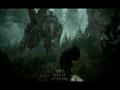

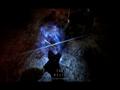
The environments look lush thanks to an abundance of vegetation and other elements, but the overall color scheme is gray and red, so it's reminiscent of titles from several console generations ago. Some of the environmental textures look bad, thanks to their unnatural shine and the particles being pared down dramatically. The game tries to lock itself to 30fps, but there is a smoothness missing that makes the responsiveness feel "off." There's also an issue with the text, which can often be too small to be readable, and there's no option to make it bigger.
Like the graphics, the sound reaches both some very high highs and very low lows. The music is moody throughout, which fits nicely with the game's ever-present gloomy demeanor. It does play throughout, so don't expect any moments where it stops playing long enough to give you a respite from the dreariness. The sound effects are fine, but the voice acting is inconsistent throughout. Some of the performances are fine, but most produce the wrong emotion at the wrong time. You'll even be surprised when some of the lines to describe the status of an object are actually read out loud. None of this is helped by a script that favors wordiness, making things far too dramatic. A bit of editing would have helped make things flow better. None of this is AI generated, but nothing sounds natural, such as a person calmly explaining that it wasn't their fault that others died while they get to live.
Despite the time that has elapsed and the patches applied on other platforms, The Relic: First Guardian remains a mess that can't address some of its shortcomings on the technically weaker platform it is running on. The combat seems decent until you reach one of the game's numerous boss fights, where the fighting suddenly feels messy. The story isn't that engaging, and it's actually made worse by the side stories, whose endings and constant repetition of facts overshadow some of the fairly intriguing narratives you would've found along the way. The presentation is also quite terrible in parts, especially the voice acting, which makes the game's long length all the more agonizing. There is still a kernel of a good game, and there is a chance that enough patching can make this a decent title, but with so many Souls-like games already on the system, even if you discount the ones created for the original Switch, there's not much reason to give this title a look.
Score: 4.5/10

More articles about The Relic: First Guardian