

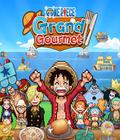








One Piece has been around long enough to get multiple video games in different genres. The Pirate Warriors series represented the Musou-style beat-'em-ups, One Piece Odyssey is one of many RPGs that have been released throughout the manga's existence, and Burning Blood has the characters in a more traditional fighting game. If you were willing to import the titles, Pirates' Carnival was the entry into board games, and Going Baseball delved into sports. Given that history, the offbeat spin-off of One Piece: Grand Gourmet actually makes sense from a series standpoint.
After a brutal storm hits the Thousand Sunny, both Luffy and Sanji are washed up on an unknown island. As they try to get their bearings, they notice two ships nearby engaged in battle, and both ships have a fish head on their masts. It turns out that a group of pirates badly disguised as crew members of the Straw Hat Pirates has been trying to pass themselves off as the Baratie, a famous restaurant ship, and a side vessel of the original Baratie was engaged in battle with them. With the battle concluded and the impostors escaping, both Luffy and Sanji offer to help set things right and clear up the name of the original Baratie while also trying to find the rest of the crew and bring the fake Baratie crew to justice.






As stated earlier, this is very different from a typical One Piece game, but it works because it doesn't stray far from its protagonist's beliefs. This is a Sanji-focused game, and his role as the ship's cook makes the idea of running a floating restaurant feel normal. The same goes for his creed that anyone gets served food, whether they are friend or foe. That normalizes the fact that the game has no combat and explains why all sorts of characters from One Piece get to appear.
Speaking of which, the game makes a concentrated effort to ensure that a ton of characters appear in the title. You'll get the usual Straw Hat Pirates crew, like Tony Tony Chopper and Frankie. You'll see friends like Koby, and enemies like Crocodile and Buggy also appear. Just about everyone from the series is present, and the game does a good job of making sure that they all make their first appearances in the same areas as they did in the manga. This is also where you realize how massive and long-running the manga has become, since we're talking about 400 characters in total.
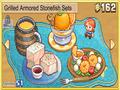
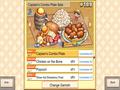
Despite Sanji being the main character, the gameplay in Grand Gourmet doesn't focus on cooking. This is more of a restaurant management game where you pay attention to several different aspects of the restaurant. The dishes feel slightly random at times. You'll get an ingredient, and then you're told that several people have an idea about what to do with that ingredient, such as a main dish, side dish, dessert, or a drink. Sanji automatically cooks it, and whatever comes out is perfect. You'll never get a situation where a dish is cooked badly. You get to choose the foods to pair with it, along with potential decorations like placemats and accessories. There are no strict requirements for any dish, so you can pair anything together, but you will want to strive for something that gets you as much cash as possible.
Restaurant decoration is also a big factor, as you can decorate the place with just about anything you want. That can be as simple as adding tables to the area or adding some décor, like lamps. Later on, you'll get to expand the physical area of the ship and change things, like the wall and floor designs. That eventually makes way for even bigger decorations like fountains and tanks to display all sorts of sea life. Like the dishes, there are no strict requirements for the decorations.







All of this is done in service to the customers, whose moods are boosted when they see decorations or dishes that they like. That mood can be boosted further when you give in to some of their requests, which include giving them specific gifts that are accurate to their character. For example, giving Koby a Marine hat boosts his mood greatly since that's who he wants to become later in life. As expected, boosting the customers' moods means unlocking more stuff, but it also means that they'll be more likely to spend more time in the restaurant and spend more money.
While most of your time is spent on the new Baratie, there is the side game where you send out Luffy and a companion to the various islands to get things. The quests are automatically completed over time, and while the result is a new ingredient, other journeys will reveal things like new decorations or characters, which come with their own recipes. The early islands can be thoroughly explored without any fuss, but later islands will have obstacles that require Luffy to be at a certain level, giving you the chance to have Luffy train under Zoro or other Straw Hat Pirate members to get stronger, so you can return to an island to unlock everything.
That is the basic gameplay loop: Start the day, send Luffy on adventures, keep the food coming, and rake in the cash. It works as an addictive loop, but it can also be a tad difficult to appreciate what you've crafted. The garish decorations capture your attention, while the multitude of characters make it difficult to parse out who's moving where. It is the typical Kairosoft style but pushed into overdrive, where even veterans of the developer's past works can feel lost.
Grand Gourmet tries to mix up things whenever a specific character is highlighted, as they have specific requirements that need to be met before they can become regular customers of your restaurant. Some of the requirements include being fed specific dishes or wanting to sit in specific areas. Completing all of those things with a high grade means getting a big boost for the restaurant, but failing to impress them means having to try again later, and there's no real penalty.







There's also the game's overall goal of beating the fake Baratie, and that is accomplished via a two-step process. First, you'll need to beat them in a few key areas, like popularity and a bigger cash flow to name a few. There's no hard deadline to get this done, but once you defeat the fake Baratie in every metric, you'll enter what is essentially a food competition where you pit your best dish against theirs in a taste test.
The over-simplification of the gameplay mechanics means that this title is intended for casual players. That isn't necessarily a bad thing, but the approach takes away all friction, since you can't lose. There's no penalty for giving people the wrong dish because everyone will eat whatever you put up in front of them without paying less — and without a hit to the restaurant's reputation. Going with clashing decorative styles also means nothing, since there are no negatives for doing so. Losing all of your cash still doesn't prompt a game over, since you've given a loan at all times. The result is a game that almost acts like an idler, with only a minimal amount of input needed from you to keep the journey going. As long as you keep the moods high and let the game choose the dishes for you at all times, you'll succeed.
Even the most casual of players will dislike how fast the game goes. This is especially true in the beginning, when the game issues a notification anytime something happens, followed by a tutorial that you'll quickly forget because something new occurs just a few seconds later. The cut scenes act in a similar manner and become worse when two pieces of dialogue are played at the same time by the same person. It's spastic, but it also fits with the game's idler status, rather than something more interactive.




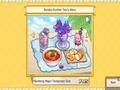


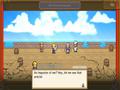
From a presentation standpoint, Grand Gourmet is both very cool and very forgettable. The characters are the highlight, as everyone is rendered with a squat pixelated style. They're all very recognizable, and although their animations are very limited, it's very charming to see everyone rendered in this way. The environments also manage to pack in lots of detail with this style, even though things are on the tiny side. Meanwhile, there are no voices, but the music leans toward the forgettable side. It isn't annoying, so you won't mind the looping, but you're not going to be clamoring to hear it more often.
The game has no performance issues if you're playing on a Linux machine. On the Steam Deck, the game runs like a dream, which is to be expected since this is also available on phones. The full 1280x800 resolution is used, and even though the game is locked to 30fps, it doesn't run any faster on other machines. Controlling with the gamepad is doable, but the mouse is better. The real treat is that the game hits over five hours of battery life on a full charge. Like the Switch and mobile versions, this game is well suited for Valve's portable device.
Your enjoyment of One Piece: Grand Gourmet is going to hinge on your love of management titles and One Piece. For fans of the latter, the large cast is going to be a dream come true, especially since their pixelated forms still impart the character and charm of both the anime and manga. Fans of the former will enjoy the game if they favor the simplicity of the game style versus wanting to balance the genre's minutiae. For everyone else, there's not much to keep people interested beyond the rapid-fire pace of the overall game, so they shouldn't feel bad if they skip this entry in favor of something more traditional.
Score: 6.0/10



More articles about One Piece: Grand Gourmet