









Before there was Halo, the leader of the first-person shooter on consoles was GoldenEye 007 on the Nintendo 64. Talk to anyone who lived through that era, and many would agree that the title was a big multiplayer staple for N64 owners and a game that was the envy of the PlayStation crowd. The funny thing is that the multiplayer gets talked about so much that not as many people remember the campaign, though those who have played it remember it fondly. The game's popularity has translated into a big amount of hype when the game was eventually released on the Xbox One via Rare Replay and on the Nintendo Switch through the N64 app on the Nintendo Switch Online with Expansion Pack service. While the first-person shooter genre has increased in popularity by leaps and bounds on all platforms, the style of game popularized by GoldenEye was left behind. That's where Agent 64: Spies Never Die comes in.
There's a story, but it takes some time before you can piece it together. The game opens with a man in a red suit helping deploy other people who are brandishing guns all over a penthouse apartment. Their assignment is to kill one man, and that man is you. As an older spy, you try to fight your way through, and you almost escape before you're surrounded by gunmen and captured. You wake up in a cell in a castle next to your daughter, who is also a spy in the same organization. It turns out that the man in the red suit is the head of a criminal organization and someone you thought you had killed. What follows are revelations of the organization's overall plans and how the man in the red suit is still alive, despite you having killed him before. Overall, the story exists as a means of connecting levels; it's not terrible nor memorable by any means.
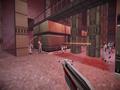
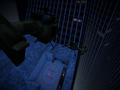
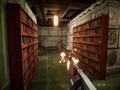
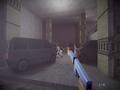
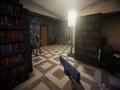
Agent 64 is a first-person shooter that needs some explaining, as it plays very differently from what modern audiences would expect. There are the usual hallmarks of a modern boomer shooter, so you'll see a mix of modern elements with classic gameplay segments. There's a dual analog stick setup for those using a controller, and you will need to reload, but you can carry as many guns as possible. There is no need to aim down sights, and is there a melee attack unless you select your bare hands as weapons. You also can't jump or crouch, and doors need to be opened manually.
It's familiar for those who are well versed in the modern incarnation of the boomer shooter, but there are a few mechanics that are uniquely GoldenEye/Perfect Dark. The first is the presence of a very generous auto-aim system. As long as you're in the general vicinity of the enemy you're trying to tag, your bullets will always head toward the enemy. Things happen within reason, where all of your pistol's bullets will aim true, but a machine gun will have some spread, but the accuracy is much higher than in other shooters. Auto-aim has been around since the Doom days, but it looks more natural in Agent 64, as your visible arm will always move around the screen space so the bullets look like they're naturally moving toward the intended spot rather than taking unrealistic curves in their travel path.
The aim down sights mechanic from modern shooting games is replaced with a more manual aiming system. Holding down the aim button produces a cursor, and you move the cursor around the screen to more accurately hit a target while you're standing still. You're introduced to the mechanic when you're trying to hit the locks on a door, but it doesn't feel intuitive because panning the cursor on a fixed screen is slow when using a controller. It's much faster to use a mouse, and it is also unnecessary since you can hit those same locks using the more traditional dual stick or mouse/keyboard layout. Admittedly, the system comes in handy when you're trying to fine-tune a spot to hit, but that's only when you're using the mouse. You will use this system with a sniper rifle, but that comes with its own problems. Aiming means zooming in on your target, but it occurs at such a glacial pace that you'll never want to use that weapon unless you're forced to. Then again, because your weapon arsenal always resets at the start of a level, you won't have to worry about lugging it everywhere and accidentally switching to it in a fight.
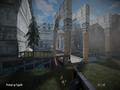

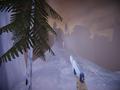
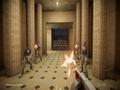
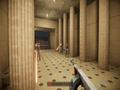
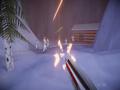
Then there's the environment. You can shoot at just about everything, and it will break. Don't expect something as extraordinary as in the Red Faction games, but it is nice to see a more reactive environment. What's distinct is that the game copies the kind of destruction seen in the Rare classics, so most things you destroy will explode. That makes sense for stuff like barrels, but it is hilarious when you see a cabinet go out with a firefly explosion followed by clouds of smoke. It's silly but also proof that the developers picked up on the small things from those old games.
The campaign stands as the main single-player mode, and much like its inspiration, there are things that you don't see in other shooters. While the objectives are varied, the difficulty level affects the number of objectives that need to be completed in a level. Play on the easiest difficulty (Agent), and you may have three main objectives to accomplish. Bump it up to the middle difficulty level (Secret Agent), and you have an extra objective that asks you with exploring an area that you'd otherwise skip. Go to the highest difficulty level (64 Agent), and the game occasionally gives you one more objective to deal with while also taking away the body armor.
Those are pretty big changes when you consider how vastly different those difficulty levels really are. Play the game on Agent, and enemies will have the aim of a stormtrooper. They'll be lucky to tag you even if you're standing completely still and they vastly outnumber you. Go up to Secret Agent, and every foe is suddenly formidable. They learn to duck and dodge, often while also having better aim. While this is a better challenge, 64 Agent difficulty can start to feel unfair because the enemy's aim is good enough that they can hit you from around corners or through crevices between larger objects, making for a significant jump in difficulty.
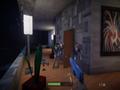
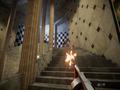
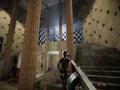
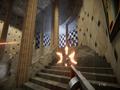
Regardless of the difficulty level you choose, the campaign is done well. The levels have some openness but are mostly linear, so you won't miss having a map or navigation system because it is nearly impossible to get lost. You're always sure that an enemy has died, since they drop their guns, which also has a knock-on effect of ammo being plentiful, since you won't find a variety of firearms available in a given level. Enemies are spaced out in a way that feels natural rather than having a bunch of monster closets stitched together. Even though death can be an annoyance due to the lack of checkpoints, levels aren't so long that it feels necessary to have temporary continue points. It all plays out smoothly and in a way that doesn't feel like the campaign drags on.
The campaign does suffer from one big annoyance: progression gating. Each of the four major acts in the campaign have cipher requirements, and those ciphers are earned based on completing levels at certain difficulties. However, unless you start playing through the campaign at the highest difficulty level, there's no way to reach the final act unless you replay earlier levels at different difficulty levels to reach the required cipher amount. You can also earn these by completing the various challenges in the campaign's Contracts sub-section, but the challenges are difficult. This design decision is disappointing, since it feels like unnecessary padding for a rather short campaign. Players already have a reason to replay levels because beating their par times unlocks rewards. Forcing them to do even more replaying just to finish the game feels tedious and unnecessary.
Speaking of contracts, that sub-section of the campaign is interesting. To open the contract, you need to find a purple mask hidden in every level. As long as you destroy the mask, you'll unlock the contract even if you don't complete the level. Playing the level again with the contract on means playing with a load of modifications on at the same time. Some can be as simple as shooting rockets faster or having infinite ammo. Others are more stress-inducing, such as everyone getting killed with one shot or trying to beat a level within a certain time. Killing people allows you to extend that timer by a few seconds. Completing each contract unlocks different modifiers that are meant to let you construct your own challenges for replaying campaign levels.
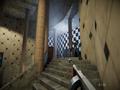
While the campaign and contracts are enough to keep one busy thanks to the many unlockables within, there are still a good number of modes present. The game features co-op play for all 14 of the campaign levels. You have Arena mode, which is going to be the main mode for those who grew up with the N64 classic shooters. The game variants are pretty basic, as you have differently named versions of King of the Hill, Capture the Flag, and Deathmatch at your disposal. You can customize the weapon loadouts for each match, so you can re-create things like playing only with a karate chop at your disposal or having matches where proximity mines are your main weapon. The game takes a page from Perfect Dark, as you can have up to four-player split-screen alongside eight bots of varying behaviors. The mode is ridiculously fun, especially for those who lived through the era when split-screen was the only way to play multiplayer, but you need to spend loads of time playing other modes to unlock stuff. The number of default available characters and levels and modifiers is quite small.
Then there's Challenge mode, which takes the Arena mode format and really messes with everything possible. Much like the Contracts, you'll play to accomplish a certain goal with loads of modifiers activated in the multiplayer levels. Unlike Contracts, the challenges occupy several different difficulty levels, so you aren't going to feel overwhelmed from the start in trying to accomplish them. The mode offers up more unlockables, since you can get one for the objective and one for completing them under a set time limit.
The good news with the online multiplayer is that just about every mode is available to use. It even has support for 16 players, with eight being human and eight being bots. The bad news is that we couldn't test out the game's online performance, since there is currently no one playing online. It is a shame but not exactly a dealbreaker, since it still has split-screen play, which is such a rarity these days.
Some portions of the audio package are quite good. The music is the real highlight, as it perfectly captures the kind of tunes that would be playing in Rare's titles. The low tempo instrumental tracks ratchet up during some firefights but don't feel overwhelming or out of place. The lack of voices might be disappointing to those whose first N64 FPS may be Perfect Dark, but it absolutely fits what GoldenEye 007 did. The sound effects are where there will be some debate. The effects from things like pistols and automatic rifles sound absolutely fine, but the explosions lack punch, which can also be said for the sniper rifles, which sound like they lack stopping power.
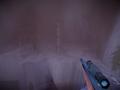
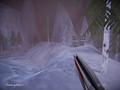
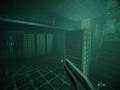
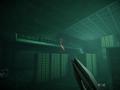
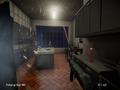
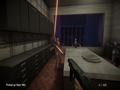
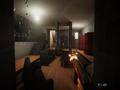
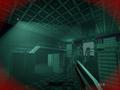
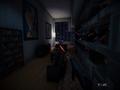
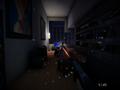
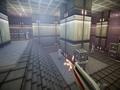
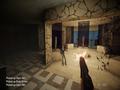
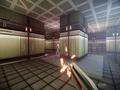
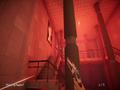
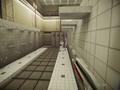
Graphically, the game adheres very closely to the N64 aesthetic. Character models are appropriately blocky, where hands are just misshapen squares, and faces are totally angular. The environments lack curves, but they're bathed in light that helps disguise the low-resolution repeating textures. The game tries to stick very closely to that original console look, but there are some improvements that make it look closer to people's memories than reality. The blur from the N64's anti-aliasing is all gone, so everything looks clean. The game does a great job of showing off lots of debris, as bookshelves leave behind loads of paper on the ground when shot, and glass shatters into little pieces and stay behind until you exit a stage. More importantly, the game hits a very high frame rate, so there's no sluggish feeling like you'd get in the original games.
The game's aesthetic choice already presents some performance expectations for the game on the Steam Deck, and those are met for the most part. The game's aesthetic fits the smaller screen and its lower resolution quite well, while the frame rate holds at a rock-solid 60fps. What is surprising is the battery life where, on a full charge with the LCD version of the Deck, you'll only manage a little over two-and-a-half hours of playtime. That's decent, but you'd expect a game that looks like a N64 title to not demand so much power from any handheld system.
Agent 64: Spies Never Die is made for a particular type of FPS fan who enjoys the specific FPS experience from the Nintendo 64 era. For those players, the experience in Agent 64 serves as that hit of nostalgia that gives you exactly what you wanted, while polishing things up just enough. For everyone else, the game is a good shooter experience with some annoying quirks that prevent the title from being an all-time great in the genre. Provided you keep expectations in check, Agent 64 is a game that shooter fans should definitely check out.
Score: 7.5/10

More articles about Agent 64: Spies Never Die