










 Silver Pines is a survival-horror Metroidvania set in small town America.
If you think of a survival-horror game, you'll conjure up a game done completely in 3D. The likes of Alone in the Dark and Resident Evil made sure that either an isometric, third-person, or first-person viewpoint were the default for the genre. Later games like Signalis have shown that a top-down view is also viable for dealing with horrors using a limited amount of resources. A 2D side-scrolling point of view isn't something that comes to mind for survival-horror, but it has been done in the past, and Silver Pines is the latest title to attempt this. We had a chance to check out the latest preview build, and we were intrigued.
Silver Pines is set sometime in the 1990s, and players take on the role of a private detective named Red Walker. You've been hired to find a musician named Eddie Velvet, who has mysteriously disappeared. Tracking down his last known whereabouts has led you to the sleepy town of Silver Pines, which has been pretty much abandoned due to a powerful storm that's about to hit the coastal town. As usual, not everything is as it seems, and soon you'll be faced with monstrosities in a place that has other unexplained phenomena.
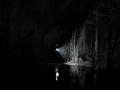
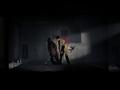
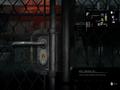
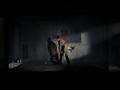
As alluded to earlier, the main thing you'll notice about the game is that it is presented from a 2D side-scrolling perspective. That's a pretty big shift, since it changes up some of the things you'd usually associate with the genre. For example, you won't turn a corner and be shocked by a monster, but the camera does play around with the horizontal scroll speed to produce some creepy effects of its own. At the same time, some other genre elements play similar to the game's 3D counterparts, such as you needing to hold down a button and fire with basic up and down and straightforward aiming.
There's not much you need to acclimate yourself with, so genre veterans can easily jump into this title without having to re-learn much. Resources are scarce, so every shot needs to count, and every healing item needs to be maximized. You have storage containers in key areas, so you can swap items, and you can only save the game in particular rooms. Inventory management is key, since not everything you get can fit in one square of your personal inventory grid. There are loads of keys and odd knick-knacks to collect to solve some basic puzzles, and there's lots of backtracking you'll do for progression. The game is being billed as a survival-horror Metroidvania, but the latter part of the description mainly refers to the game perspective and map navigation; having to backtrack through environments has been a hallmark of survival-horror games for a while.
There are a few interesting wrinkles from a mechanical standpoint. The first is the presence of a stamina meter. Performing a dodge drains this meter, as does a swing of a melee weapon, both of which are essential when you're fighting off enemies and don't want to use precious ammo. Fights against even normal minions requires you to be cognizant of whether you're in a position to dodge and counter, which is important since you can only take a few hits before you die. Interestingly, those two actions are the only ones that consume stamina. Running doesn't touch the meter at all, so you have a bit of a reprieve. It also prevents the game from feeling completely like Dark Souls.
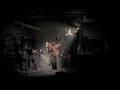
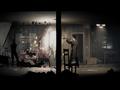

The second is the presence of a memento system. Unlike most other objects in the game, these aren't used for puzzles. Instead, they're used as buffs for your abilities, such as getting more health recovery from items or being able to reload faster once you have them equipped. This is an unusual thing to put into a survival-horror game, as the genre isn't known for making the character stronger via buffs. The mechanic sounds like it can put an interesting wrinkle in things, depending on how many the game will have in total and how many you can equip by the end of the journey.
The final thing is the lack of a pause feature, much like in Dead Space. You can bring up menus and maps, but the game never pauses. That becomes critical when you realize that the game has you do a few things manually. Reloading a gun requires you to hit buttons to load each bullet, and you need to do the same to add tape to a knife to repair it or increase its durability. The lack of a pause feature can feel like a gimmick to some, but it does a good job of maintaining the game tension.
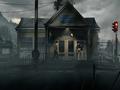
This all comes together in a setting that's reminiscent of the early Silent Hill titles. A sleepy small town is always perfect for horror games, and this is especially true of a town that seems to have a duality to it. Monsters appear in both realities, and some things are only present in the world bathed in red, such as a whole nightclub appearing below a motel gift shop. You play as an otherwise ordinary person who keeps seeing visions as he jumps from one reality to another. There are no jump-scares so far, but the feeling of unease permeates the more you travel around the town, and the execution is promising.
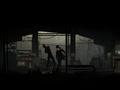
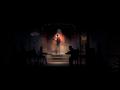
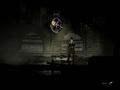
Beyond the fact that the game is presented from a side-scrolling viewpoint, the presentation is arresting for a few other reasons. The graphical style adopts a look reminiscent of full color gritty graphical novels. The environments are dour but sport loads of details, while the characters are rendered in slightly brighter colors but not bright enough that they look out of place. The animations feel like they were rotoscoped but with some animation frames missing, further adding to the game's striking appearance. Meanwhile, the audio is excellent so far, with the sound effects being played at a much louder volume to amplify a spooky atmosphere. The voice acting is also good, albeit with a calmer delivery than expected from the genre.
Silver Pines definitely looks intriguing. The side-scrolling perspective and overall visual appearance provide a good hook, while the survival-horror elements are solid enough to back up an effective storyline. Silver Pines may not have a solid release date yet, but it's definitely on the radar of horror fans, and we can't wait to see more of the game.
More articles about Silver Pines