





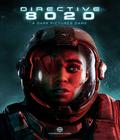
 Part of the Dark Pictures series of games, Directive 8020 is an all-new sci-fi survival horror adventure.
Since the release of Until Dawn roughly 13 years ago, Supermassive Games has focused on horror games. In particular, it has focused on horror games that are wrapped in the mechanics of a modern-day adventure game where you'll watch the narrative unfold via long cut scenes. The main gameplay highlight is making one decision after another and watching the consequences spiral from there. The developer has done enough of these over the years that it's even tied together almost all of the titles under The Dark Pictures moniker. Directive 8020 unofficially marks the second season of The Dark Pictures series, and it does so with some gameplay decisions that can be divisive for longtime fans.
The game is set in a future where the Earth is dying and there's an accelerated search for a new habitable planet for humankind. The massive exoplanet Tau Ceti f has been deemed a possible candidate, and a mission to send a scouting party to the planet is underway. However, the journey has taken an unexpected turn when the scouting ship Cassiopeia was hit with a rogue asteroid that has a hostile alien life form. With the alien's ability to disguise itself as anyone, it falls on the crew to find and exterminate the creature before everyone onboard perishes.


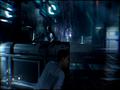


Those familiar with Supermassive's recent catalog will feel right at home with the gameplay. When you're not watching a cut scene, you'll spend much of your time exploring one environment after another, occasionally stopping to inspect points of interest, such as old video diaries or digital posters promoting the mission. Along the way, you'll encounter quick time events that have you doing things like unlocking doors or putting up barricades. You may also need to vault over small ledges, crawl through air vents, or remotely activate devices with the press of a button. Beyond that, you can communicate with others through a messaging app, use a radar to locate door switches, and send out a ping that points you toward your current main objective.
Like many modern adventure games, the main attraction is player choice. Throughout the story, you'll regularly be presented with two different responses, each with the potential to alter its trajectory. There's plenty of time to make your decision, so there's little pressure to choose quickly. That's a nice touch if you prefer to think things over, but it also means that letting the timer expire isn't a hidden third option. None of your choices lead to dead ends, so if a character dies, the story simply continues with one fewer person involved. That branching narrative has always been the defining feature of Supermassive's games, and that tradition continues.
Aside from its setting, Directive 8020 introduces a few changes that set it apart from Supermassive's previous Dark Pictures games. The most noticeable is the absence of a host. Unlike the other entries in the series, and to a lesser extent Until Dawn, there's no central figure to recap the story or help move along the narrative during slower moments. Instead, each episode simply ends with a few reflective comments from different crew members. It's not necessarily an improvement or a drawback, but it is something that returning players will notice if they're familiar with Supermassive's earlier titles.
Another addition is the inclusion of stealth. You can crouch and move quietly to reduce the amount of noise you make, or you can break into a run and vault through windows when the situation calls for it. During these sequences, you can still use the same exploration mechanics as before, such as remotely activating switches or playing videos to distract whatever is hunting you. Beyond that, the stealth options are fairly limited. Don't expect mechanics like hugging walls or other advanced stealth techniques.

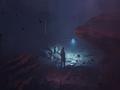
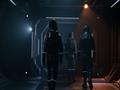


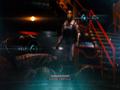
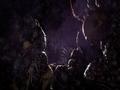
Even in its simplified form, stealth should create a sense of excitement or dread, since one wrong move can mean death. Instead, several issues keep these sections from being genuinely tense, and they all stem from the creatures you're trying to avoid. Their patrol routes are overly predictable, and they repeat the same voice lines so often that they lose much of their menace. Their vision and hearing are also surprisingly limited, so you practically have to walk directly in front of them or repeatedly step on broken glass before they become a real threat.
These shortcomings should make the stealth sections feel trivial, but the game introduces a different problem with its camera system. Whenever you change direction from left to right, or vice versa, the camera shifts to place your character on the opposite side of the screen, revealing more of the environment. That works well enough until you need to change directions quickly, at which point the camera becomes noticeably jerky. Rotating the camera during these transitions only makes things worse, often leaving you briefly disoriented at the worst possible moment. On its own, this might be easy to overlook, but because the game relies so heavily on stealth, the awkward camera makes these sequences feel more tedious than tense, especially when you're spending so much time crouching and slowly creeping toward the next objective.
The biggest gameplay addition is the new Turning Points system. Whenever you reach a major decision, the game records that moment on a separate screen that you can access at any time. From there, you can replay any previously reached choice to see how a different decision changes the outcome if you aren't satisfied with your original result. There are no restrictions on how far back you can go, so you can replay an entire episode if you want. It also effectively functions as a form of save scumming, letting you keep your previous decisions while revisiting earlier sections if you think you missed a secret or want to see another outcome.
For an adventure game built around player choice, the Turning Points system can have a significant impact on how you feel about the experience. On the one hand, it's an excellent way to visualize each chapter's branching paths. Completionists will appreciate being able to pinpoint exactly where to revisit, while players hoping to achieve the best ending on their first playthrough will find it especially useful. On the other hand, the feature undercuts one of the genre's defining appeals. By allowing you to freely undo decisions and correct mistakes, it removes much of the tension that comes from living with the consequences of your choices. It also lets you view every branch within an episode and clearly spells out the requirements to reach them, rather than leaving players to piece together those outcomes on their own. The system is entirely optional, and you can choose a classic mode at the start of the game that disables it, but its inclusion is likely to remain a divisive addition.
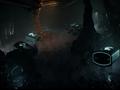





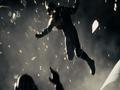
With gameplay ranging from merely adequate to disappointing, the story carries much of the experience, and for the most part, it succeeds. There's nothing especially new or original, so if you've seen films like "The Thing" or the original "Alien," you'll know the basic setup: The crew is picked off one by one, while a shapeshifting alien ensures no one can trust appearances alone. It's a familiar formula, and that predictability keeps the game from being particularly scary, although it deserves credit for avoiding an overreliance on cheap jump-scares. Even so, the story remains engaging, largely because your choices determine how many crew members survive. The biggest drawback is the frequent use of time jumps to alternate between stealth and exploration segments. Rather than enhancing the narrative, they often reveal who survives long before those events occur chronologically, undermining some of the tension and emotional investment along the way.
The characters fare better overall, largely because they're noticeably more mature than the casts from previous Dark Pictures games. They feel like believable adults, and there isn't anyone you'll immediately want to see eliminated, which speaks well of both the writing and the performances. The one exception is the CEO funding the mission, whose portrayal feels more like a reflection of current attitudes toward C-suite executives than the actor's performance. It's a solid ensemble with generally likable characters, but they're undercut by a personality meter that tracks their progress toward predetermined traits. While it suggests your choices will meaningfully shape their development, the characters still follow the same major emotional beats regardless of how those meters change, making the system feel more misleading than impactful.
Graphically, the game is mostly impressive. The sterile interior of the ship is transformed into a fitting horror setting through its dark lighting and constant organic growth, while the red-hued landscape of Tau Ceti F also looks striking despite its barren appearance before terraforming begins. Enabling ray tracing improves the visuals further, though the game still looks very good with the feature disabled. Path tracing, however, only provides a minor visual upgrade, and the fact that even an RTX 5090 requires DLSS to maintain 60fps with the feature enabled, while also introducing noticeable ghosting, makes the trade-off difficult to justify. The character models are generally well done, but something about them feels slightly off. Whether it's unusual facial proportions or moments of uncanny valley, you'll likely notice that something isn't quite right after spending enough time with them, even before the alien's shapeshifting abilities enter the picture.
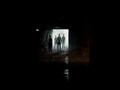





Like the visuals, the audio is generally excellent but comes with a few odd choices. The voice acting is a highlight, supported by a script that ensures none of the characters come across as poorly written or unnatural. The music is used sparingly during gameplay, but it does a good job of enhancing the atmosphere whenever it appears. However, the soundtrack takes a strange turn at the end of each episode, where a full rock song plays during the credits. That kind of choice feels more fitting for a horror story centered around teenagers, but it clashes with the tone of a sci-fi setting featuring a crew of older professionals.
The game runs without any major issues on Linux PCs, and no special version of Proton is required to get it working. Steam Deck users will find that it performs well enough, as long as expectations are kept in check. The game includes a Steam Deck preset that lowers all graphical settings to Low, uses TSR upscaling with the Performance preset, and caps the frame rate at 30fps. The result is surprisingly solid, with the game still looking good, minimal signs of upscaling, and a cinematic frame rate that doesn't create any issues during quick time events. As is often the case with demanding games on the Steam Deck, battery life is the main drawback, with the system lasting around 90 minutes on average. That's enough time to complete an episode before needing to recharge.
Directive 8020 ends up being a solid adventure game overall. While the story is enjoyable, it is also heavily reliant on familiar ideas due to the popularity of the films that inspired it. The characters fit well within the narrative, and the series' foundation of exploration and difficult decision-making remains as strong as ever. The ability to alter your choices at any point can be a positive or a negative, depending on how strictly you want to follow the genre's traditional rules. The addition of stealth ranges from a welcome change to an unnecessary mechanic due to its limited execution and frequent use. Directive 8020 may not be the best entry in the Dark Pictures series, but it is encouraging to see Supermassive experiment with ideas that don't completely undermine the experience. Adventure game fans and those curious about the series' direction will still find enough to make it worth checking out.
Score: 7.0/10



More articles about Directive 8020