







 LEGO Party! is a 4-player party game that allows you to customize a LEGO minifigure and compete in 60 minigames themed around fan favorite LEGO sets.
Games like Crash Bash, My Street, Shrek Super Party, and Sonic Shuffle are just a few attempts to emulate and capitalize on the success of the Mario Party series. A few were decent, but none recaptured the magic of Nintendo's long-running series. More recent attempts, such as Demon Slayer -Kimetsu no Yaiba- Sweep The Board, haven't come particularly close either. LEGO Party is the latest challenger, and for the most part, it succeeds.
If you're familiar with Nintendo's party game, you know what to expect. Four players, which can be any combination of humans and bots, compete on a board where spaces can increase or decrease studs — one of two currencies used to open pathways and buy items. Other spaces trigger traps or global events, but the primary goal is collecting gold bricks, either by buying them with studs or earning them through other means. Whoever has the most gold bricks at the end wins. Players also compete in minigames each round and earn studs based on their performance.

LEGO Party has several modes, with Challenge Zone serving as its main board-game mode. It plays like a televised game show, complete with commentators reacting to the action. While much of it follows the Mario Party formula, several additions give it an identity of its own. The biggest change is that minigames take place at the start of each round, rather than the end. Their results determine turn order, so finishing third in a minigame means taking the third turn in that round. This adds stakes to each minigame and prevents players from being stuck going last because of an early bad roll.
Players can also vote on which minigame to play. At the start of each round, everyone has a few seconds to choose from three options, with the most popular winning. A fourth option always selects a random game for those who prefer traditional randomness. Voting also applies to end-of-game bonus bricks, assuming that feature is enabled. While the bonus categories can still be based on arbitrary goals, such as rolling a "4" throughout the game, players collectively choose which categories are used rather than leaving the decision entirely to the game.
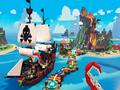
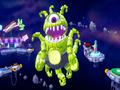
The boards offer additional variety through construction spots. One might have you build a cove where treasure appears at random locations, while another lets you construct theme-park rides. Near the end of a game, each board can also undergo a major transformation, such as fighting a giant alien in space by reaching red buttons or defending the land from Ninjago villains. These variations add replay value because a single playthrough can't showcase everything a board has to offer.
Together, these changes make LEGO Party feel both fresh and familiar. You can preview the entire board when choosing a path, and every minigame can be practiced for as long as you want before playing it for real. Moving between this and Mario Party therefore feels natural, with few major differences in their basic conventions.
The game also features a highly customizable rule set that can make matches more accessible to younger players. For example, you can give them gold bricks at the start to level the playing field against older players. Almost every major rule can eventually be adjusted, but the full customization system isn't available until you've played for a while.
The biggest weakness of the standard formula is the number of boards. There are only four: a pirate-themed location, a varied theme park, outer space, and a Ninjago world. Their construction mechanics and transformations provide plenty of variety, but four boards is still a small selection, matching the number Super Mario Party launched with. The lack of DLC means the game remains a complete package without additional purchases, but more boards would've provided a good reason to return after exhausting the existing variations.
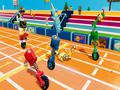
Fortunately, the minigames are thoroughly enjoyable. There are 60 in total, ranging from familiar concepts to more unusual ideas. One has you balancing on a unicycle for as long as possible, while another asks you to collect specific pieces and place them in a bin. There's also mini-golf, a game where you're catapulted toward a target while collecting bonus items in midair, and plenty more.
Most minigames are free-for-alls, with a few 2v2 games mixed in. There are no 1v3 games, which is helpful for younger players who might otherwise find themselves consistently outnumbered. Controls are generally simple, but a few are unnecessarily complicated. One driving game, for example, assigns each face button to a different wheel, and the mapping makes little sense.

The other modes are competent but unsurprising. Minigames can be played individually or in themed sets, making it easy to play a selection without choosing each game manually. The final mode is a single-player score attack in which you attempt to achieve the highest score across five minigames. It works well enough, but with such a limited pool of games, it feels more like a novelty than a mode you'll return to regularly.
Progression is handled through an XP system divided into five categories: one for your overall profile and one for each of the four boards. Milestones unlock characters, while others award carrots, a separate currency used to unlock characters of your choice. Importantly, all currencies can be earned through gameplay, so there is no need to worry about a microtransaction-driven progression system.
There's also no shortage of characters. More than 50 are available from the beginning, ranging from animals in suits to robots, spacemen, and construction workers. Most characters can have their individual pieces mixed and matched, creating an enormous number of combinations before you unlock anyone new.
The main disappointment is the lack of licensed LEGO characters. Given the cost associated with licensing, their absence isn't surprising, but it is still unfortunate. Ninjago is represented, but Bionicle gets only a single character, while LEGO Friends is absent entirely.

The Switch 2 version arrives just under a year after the original Switch release. Differences between the two versions are minimal, with Switch 2 offering higher resolution and a higher frame rate. There is no improved rumble or exclusive Joy-Con 2 functionality. That's not necessarily a problem, especially since cross-play with the original Switch version remains intact. The online player base is understandably small by now, though. Existing owners also receive the Switch 2 upgrade for free, so there's little reason not to upgrade unless storage space is at a premium.
Beyond resolution and frame rate, the graphics remain largely unchanged. The game still looks good and fits comfortably alongside previous LEGO titles, although it lacks the more advanced lighting seen in something like LEGO Batman: Legacy of the Dark Knight. Animations are particularly strong, especially during the sped-up, stop-motion-style construction sequences. Performance is generally solid in both docked and handheld modes, with only occasional brief slowdowns.
The audio is similarly strong. The music suits both the game-show presentation and individual board themes, while the sound effects are consistently satisfying. The standout feature, however, is the commentary. If you're not a fan of kid-oriented humor, you may find it grating, but the two commentators have convincing chemistry and constantly react to what's happening.
More importantly, their dialogue is highly context-sensitive. They'll comment on a player's performance, note when someone in last place earns a gold brick and mounts a comeback, criticize a bad roll, or question a player's choice of destination. A few lines repeat, but the game rarely feels like it's running out of things to say, and dialogue doesn't abruptly cut off when you skip scenes. You can disable the commentary entirely, but keeping it on lets you see how long the game can maintain its reactions.
In the end, LEGO Party is a solid companion to Mario Party. Its rule customization can reduce some of the genre's randomness, while its minigames provide accessible, straightforward fun despite a few overly difficult or awkwardly controlled entries. The boards offer enough variety that several playthroughs can feel different, even if four boards aren't enough to sustain the game indefinitely. Presentation is strong across the board, and cross-platform play is a welcome addition despite the small online community. For party-game fans looking to spend some time away from the Mushroom Kingdom, LEGO Party is a worthwhile alternative.
Score: 8.0/10
More articles about LEGO Party!