







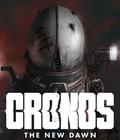
 Cronos: The New Dawn is a sci-fi survival horror game with a twisted time travel story set in an unforgiving post-apocalyptic future in 1980s Poland.
Of all of the major platform holders, Nintendo has seen its consoles house the smallest library of horror titles to date. They've certainly had some of the big names in horror, like Eternal Darkness: Sanity's Requiem, the Five Nights at Freddy's series, and just about every entry in the Resident Evil series, but other big names in the genre have gone missing. With Cronos: The New Dawn, developer Bloober Team has created what is essentially an amalgamation of ideas from other survival-horror games fused together, and the result is quite good if you're into brutality.
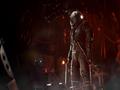
Players take on the role of The Traveler, a woman wearing a large and bulky suit of modern armor. You are awakened by a disembodied voice that represents an organization known as The Collective, and you encounter a battery of monitors meant to re-orient you once you're conscious. After a successful orientation, you're given a transforming pistol and the primary task of finding a previous Traveler. Your secondary task is to learn how to stop a phenomenon known as The Change, which has turned the people of Earth into flesh-hungry creatures known as Orphans. To achieve this goal, you must seek out rifts that transport you to 1980s Poland, so you can gather the essences of people who The Collective considers to be important.
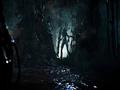
As with many of Bloober Team's previous games, the story is packed with twists. Your primary objective shifts multiple times, while the origins of both the Orphans and the Change are repeatedly recontextualized. The motivations of the people you meet, as well as those of The Collective, also undergo dramatic reversals. These constant revelations never become confusing, but they reinforce a classic horror and sci-fi theme: Nothing should be taken at face value. Combined with the discovery that the Essences are causing hallucinations, the result is an intensely oppressive atmosphere. The approach works well within the narrative and its multiple endings, provided you aren't committed to the idea that every story needs a happy ending.
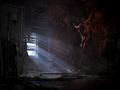
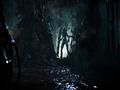
The game uses a third-person perspective and incorporates many familiar genre conventions. An over-the-shoulder camera comes into focus when aiming firearms, while an abundance of written notes and audio logs helps flesh out the narrative. Orphans often emerge after you collect important items, and several distinct enemy variants appear throughout the game. The environments blend crumbling debris with grotesque biological growths that serve as walls, barriers, and gateways. Inventory space is limited, and resources are scarce, creating a constant sense of tension as you explore.
Many of the features that help the game distinguish itself from modern entries in the genre are actually borrowed from much older survival-horror titles. The use of dedicated save points and large storage chests to offset limited inventory space is a clear nod to the original Resident Evil games. This influence is especially apparent because all of the storage chests are linked, allowing items stored in one location to be retrieved from another. Fortunately, every item occupies only a single inventory slot. Even so, the limited space encourages careful resource management, often requiring you to craft ammunition and healing supplies proactively to free up room for other essentials.
The emphasis on limb damage immediately draws comparisons to Dead Space. While headshots are still effective for eliminating Orphans, targeting limbs is often preferred as a way to conserve ammunition and make melee combat more viable. The ground stomp is particularly useful, since the basic punch feels relatively weak. Even when enemies are knocked down this way, they do not die unless their bodies are burned. This mechanic becomes more important later, when it's revealed that living Orphans can merge with corpses to create new and more dangerous variants. For instance, acid-spitting enemies may suddenly gain additional armor, forcing you to expend significantly more ammunition or retreat.
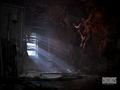
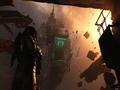
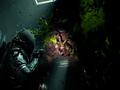
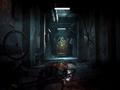
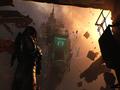
Of course, this is easier said than done. Until you fully power up your guns and suit, your shots feel almost pitiful; even the most basic Orphan can resist nearly all of your shots. You can charge your shots to increase their impact, but doing so takes time, and you can't store a charged shot, since it immediately discharges once charging is complete. The limited ammunition already pressures you not to miss, and this is made worse by the fact that it only takes three good hits to kill you. This tension escalates further when you face multiple Orphans at once in tight areas with little room to maneuver.
The idea of maneuverability is questionable at best. You can't perform a quick turn, dodge in any form, or jump at all. Your walking speed is what you'd expect from someone encased in bulky, space-age armor. You can run without a stamina meter and vault over waist-high obstacles, so you aren't completely helpless, but don't expect to dance around enemies. As a result, combat often feels like it draws inspiration from Dark Souls. That comparison may sound trite, but it accurately captures the situation. You need to keep your distance if you plan to charge shots, and unless you can reliably land headshots, targeting limbs becomes your most practical option. Thoroughly burning corpses is ideal if you have a limitless fuel supply, but sometimes it's smarter to let an Orphan complete a merge if you can retreat safely without being followed. Like any good survival-horror game, the combat encourages careful, deliberate play. The only real exception is boss encounters, where this structure breaks down. The merge mechanic doesn't occur during boss fights, so those encounters feel more traditional by comparison.
Outside of combat, Cronos does a good job of giving you a few areas to explore, despite it being a mostly linear experience. The puzzle-solving is light but fun thanks to some of the tools at your disposal. From gravity boots to a gun that lets you change the status of an object depending on the time period you use as a source, there are some pretty cool moments that break up the tension.
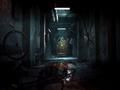
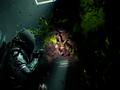
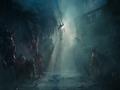
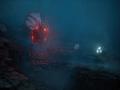
The Switch 2 is a system that continues to be graphically impressive, considering its low power and specifications. Cronos does a very good job in underscoring that point. The overall look matches what you'd see on the other consoles thanks to the use of DLSS to upscale things. The design of The Traveler matches the kind of style you'd expect from the time period, while the Orphan and boss designs are grotesque in a good way. HDR also helps give each scene the perfect amount of lighting, but it also makes you wish the Switch 2 had an OLED screen or a better LCD one to take advantage of this feature. The one time you'll notice anything bad is when you look at things with tiny bits of detail, like a VU meter, and you see it fizzle from an unintelligible mess to something cleaner in a matter of seconds. The only other thing is that some of the ground textures never get cleaned up, leaving you with some very low-resolution textures to look at when your light shines on them.
Sound-wise, the game is solid. The sound effects do a great job of creating an uneasy atmosphere with the constant presence of guttural Orphan noises being mixed in with the sounds of wet flesh in confined areas. It's played just enough to keep you on edge, even in supposedly safe areas. The music is a mix of traditional survival-horror fare with some synthwave stylings, making it perfect for the 1980s Polish setting. The voice acting is good enough, depending on what you're listening to. The Traveler's voice is borderline robotic but fits the character perfectly; her deadpan delivery only lets up near the end. The performances of the other people are also good but can falter every now and then, depending on the lines.
Cronos: The New Dawn is a strong choice if you're looking for a bleak survival-horror experience where scarcity is the norm and careful conservation is essential. The game works because it feels like you're pushing back against its intended difficulty rather than systems that are working against you. Every encounter demands effort, so even simple victories feel genuinely earned. At times it can be unforgiving, but it never feels unfair. If you've been looking for a survival-horror experience that (imperfectly) hearkens back to the classics, Cronos is likely to be on your radar.
Score: 8.0/10
More articles about Cronos: The New Dawn