


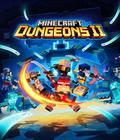
 Minecraft Dungeons II is the next chapter in the action/RPG series, introducing new locations, enemies, and high-stakes encounters across the Minecraft universe.
The original Minecraft Dungeons provided a blueprint for adapting something as daunting as a dungeon crawler for a younger audience. Some design decisions may have seemed too simple for genre veterans, but they proved effective for players who wanted something easy to grasp without the usual complications. Now comes the aptly named Minecraft Dungeons II, which introduces some significant changes while retaining the identity and charm of its predecessor.
The story takes place sometime after the first game. Peace has returned to the world, but the self-appointed High Council of Illagers has been working in secret. They've opened a portal to another world called the Sift and are draining its life force to build an army for world domination. As the returning heroes, you once again take up your weapons to stop the High Council and save both worlds.


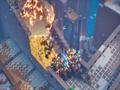
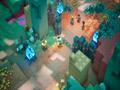
Like the first game, the story is fine. It's familiar fantasy fare, but it fits the medieval-like setting well. Having a narrator drive the story also works because it allows the player characters to remain without fixed personalities. However, the story loses some impact because no one actually speaks beyond a few grunts. The characters are less expressive than LEGO characters, making the game's pantomime less effective.
Minecraft Dungeons II remains an action-RPG with many of the same traits as its predecessor. You can play solo or in co-op with up to four players, either online or offline, with cross-play and drop-in/drop-out support. The classless system means there are no predetermined party roles, giving everyone freedom in how they build their character. Every player has access to a melee weapon, bow, items, armor, and a healing potion with unlimited uses gated by a cooldown. The game uses an isometric viewpoint with a locked camera, and attacks only affect enemies, preventing friendly fire and accidental animal casualties.
As with any good sequel, the mechanics have received some substantial changes. Cooldowns appear to be shorter than in the first game, although the lack of a numerical timer makes that difficult to confirm. Playing both games back-to-back, healing and item abilities do seem to be available more often. Arrows are no longer finite, either. You can still fire only a limited number in quick succession, but your quiver regenerates over time, making ranged combat a much more viable strategy for players who prefer to fight from a distance with occasional melee attacks. Automatic aiming has improved as well: if an enemy is highlighted, you'll generally hit it, although there are still moments when an attack inexplicably lands on the ground.
The equipment system has expanded, too. Instead of one general armor slot, you now have four, with separate slots for boots, helmets, pants, and upper-body armor. Each piece can carry enchantments, and the system has been greatly expanded. Enchantment books can be found throughout the world, and most enchantments can be applied to both equipment and weapons. This makes it easier than ever to create an unexpectedly overpowered build, although enchantments aren't available until later in the campaign, keeping you from becoming too powerful too early.
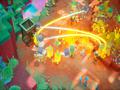
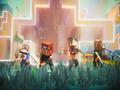

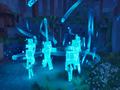
Movement has also improved with the addition of a jump. At first, it seems like a novelty, especially since you could already cross chasms with a dodge roll. It quickly becomes more useful when you're surrounded by mobs and can leap over them, and it enables jumping attacks that deal more damage at the cost of attack speed. More importantly, the jump adds verticality to the game. The worlds aren't completely flat, and climbing hills or reaching elevated positions can give you opportunities to attack without being hit. This adds more strategy than expected from such a simple mechanic. The jump isn't perfect, though; some level layouts make spaces look accessible when they're actually blocked by an invisible boundary.
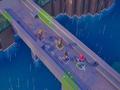
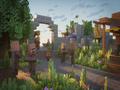
The biggest change is the world itself. Instead of separate levels with distinct biomes, you now have one large open world. Fast travel via minecarts is available, but traveling on foot lets you farm enemies for XP. The world is also packed with small secrets that lead to random loot, and everything respawns when you reload a save, giving you plenty of reasons to revisit areas even if it means fighting the same difficult mobs again. The open-world structure creates room for more side quests and random boss encounters, such as an Enderman appearing unexpectedly. The change from structured levels to an open world completely alters the game's feel, although the Sift retains the preset level structure. That distinction helps the two dimensions feel different beyond simply giving one of them a different color palette.
Despite these changes, the game retains the elements that make it accessible to casual action-RPG players. Equipment is still simplified, with a general power number rather than a long list of stats. Higher numbers usually mean better gear, but inherent weapon and item buffs still give you reasons to consider which piece actually suits your build. There's no level requirement for equipment, so finding a powerful item never means waiting several levels before you can use it. Combat remains satisfying because you start strong and can kill plenty of enemies with a single arrow. Enemy scaling increases as you level, but you rarely feel too weak to handle a particular mob. You can still become overwhelmed when playing solo, especially when 20 enemies converge on you, but the game generally avoids making encounters feel unfair.
Leveling is similarly streamlined. There are no skill trees or points to allocate; progression happens automatically. Players looking for substantial action-RPG depth may find this limiting, but that's not really the game's goal. Minecraft Dungeons II is designed for younger players and anyone who wants to fight monsters and bosses without managing a complicated character build.



There are still some areas that could be improved. There's no magic system or crafting, although adding crafting would arguably work against the game's emphasis on simplicity. Pets are fun but largely cosmetic. Automatic aiming can struggle to prioritize targets in crowded fights, and the quest system occasionally broke during my playthrough, requiring a restart. Restarting is particularly frustrating because the game takes a long time to fully exit. When launching through Steam Big Picture mode, the menus can become unresponsive long enough to make you wonder whether the system has crashed. Some of these issues may be addressed in a patch, particularly since this was a press build, but they're worth noting for anyone concerned about the day-one experience.
The audio is strong overall. The music balances whimsy and epic moments, fitting both the action and Minecraft's identity. Sound effects remain clear even during hectic battles. The narrator is the only character with a voice, and she gives the adventure an appropriate sense of gravitas without overdoing it. It would still be nice to hear the other characters speak, but the approach works well enough.
Graphically, Minecraft Dungeons II makes modest improvements over the first game. The day-and-night cycle gives the lighting more prominence, while particle effects have received some upgrades, such as more detailed-looking voxel explosions. Otherwise, the game remains visually familiar, with lush environments and characters that retain Minecraft's distinctive blocky aesthetic. Performance is smooth even when large numbers of creatures are on-screen. The biggest disappointment is that cutscenes are pre-rendered and locked to 30fps. They're perfectly fine, but since they don't appear to do anything particularly demanding, rendering them in-engine would have been preferable.
Linux players will be disappointed to learn that the game doesn't currently run properly on the platform, and Steam Deck owners face the same problem. The game launches, but the setup asks whether you want to install additional game services, presumably the Xbox login software. Regardless of your choice, you're eventually kicked back to the Steam menu. This is particularly disappointing given that ProtonDB reports the first game runs well on Linux. However, this is a press build, so there's still a chance the retail version will include the changes necessary for proper Proton compatibility.
Minecraft Dungeons II improves on the original without abandoning what made it appealing. The open world provides plenty of opportunities for exploration, secrets, and loot, while the expanded equipment and enchantment systems offer greater flexibility without becoming overwhelming. The shops have improved as well, and combat can be chaotic when playing solo without ever feeling unfair. Players looking for a deeper action-RPG may still find the experience lacking, but those who want a straightforward adventure with a lengthy campaign will find Minecraft Dungeons II to be a satisfying sequel.
Score: 8.0/10
More articles about Minecraft Dungeons II