






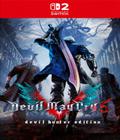
 Several years have passed in Devil May Cry 5 Devil Hunter Edition, and although Dante is missing, the threat of demonic power has returned.
Originally released in 2019 on the PC, Xbox One, and PS4, Devil May Cry 5 was a brilliant action title. The title did a superb job of encapsulating what made the series an instant classic when it debuted in the first year of the PS2's existence and did so without any glaring flaws. The Xbox Series X|S and PS5 versions upped the resolution, had modes that let you run with different frame rates, and gave fans the ability to play as Vergil throughout the whole campaign. Little had changed, but that didn't matter since the game remained excellent in its transition to the newer consoles. The second season of the animated Netflix show is in full swing, so Capcom thought it was time for the game to arrive on the Switch 2 with Devil May Cry 5: Devil Hunter Edition.
In DMC5, Red Grave City has been invaded by a giant demonic tree and the demons lying in wait within. You first encounter Nero and a new character named V, as they're already inside the tree trying to catch up to Dante, who is already fighting with the head demon Urizen. By the time they reach the main chamber room, both Lady and Trish have been knocked out cold while Dante has been winded from an attack. After a failed battle with Urizen, both V and Nero are forced to retreat while the city remains under siege by demons. One month later, Nero returns to the town with his friend and weaponsmith Nico, vowing to rescue Dante and put an end to the invasion.


Although the plot is solid enough for these types of games and has some good twists along the way, the characters and gonzo incidents are really what drive the series. Nero's cocky attitude and penchant for quips immediately comes through in the opening sequence, and it stays throughout the game, especially with boss encounters. He does get his fair share of cool but ridiculous cut scenes. The title sequence sees him jump through a moving van's window to dispatch some demons before jumping back into the passenger's seat of said van. That same sequence also has Nico driving the van recklessly to hit some demons. Her own cocky attitude and Southern accent make her an immediately likeable sidekick. Dante is pretty much the template for Nero as far as attitude goes, while V's demeanor is a nice change of pace, since he's more reserved and his only signs of attitude involve reading poetry out loud.
Since the first three Devil May Cry games are available on the Switch, the absence of Devil May Cry 4 stands out as a significant omission. This is especially noticeable because Nero, who was the protagonist of Devil May Cry 4, plays a major role in the story. As a result, Nintendo players miss a key chapter in the series that introduces and develops one of its central characters.
There is a general recap movie in this game that gives you a synopsis of all of the events of the older mainline games (DmC: Devil May Cry excluded), but it would've been nice if Nintendo fans who have only ever played the series on the Switch got to play that game as well. The game's absence is especially felt when you realize that prior to the release of Resident Evil Requiem, both the seventh and eighth entries in the series were released on the Switch 2 so system owners could experience those titles.
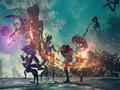
The core gameplay loop hasn't changed from its predecessors. While you do encounter small pockets of enemies that roam freely in the environments, most of your enemy encounters and all of your boss encounters tend to take place in wide but closed-off arenas where the only way to get through is to kill everyone that spawns inside. Each battle you encounter is graded with a letter system that goes from D to SSS, and that grade is wholly dependent on you not getting hit and getting in lots of hit combos in a short amount of time. Combos are lengthened with projectile weapons, but your melee moves are the ones that'll boost the letter grade significantly. Multi-hit moves and juggling enemies in the air is something you'll be doing often in addition to dodging and dealing with multiple enemies and enemy types. Aside from that, you'll mostly collect different gems that boost your health, refill your Devil trigger meter for special abilities, and obtaining currency to buy combos and abilities to keep the combo cycle going.
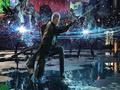
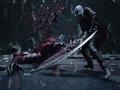

DMC5 gives you three different heroes to play with, and while their core gameplay mechanics are similar, there are some big differences between all of those characters. Dante is the most familiar of the trio, since he's been their hero for most of the games thus far, and his move set is based on what he had in Devil May Cry 3. His arsenal of firearms is small, and the same goes for his melee weapons, but he can switch them out at any time. He also has four different fighting styles that either emphasize swordplay, gunplay, a balance of both, or defense.
Nero is very similar to Dante in that he has a pistol and a sword, but he doesn't have other weapons or fighting styles. His sword can be charged up from a stronger attack, though. Instead, he can grapple enemies from a distance, so he can either pull himself toward them or vice versa to continue combos or have a handy escape path. He also has the Devil Breaker, which is basically a prosthetic arm capable of a few other things. Depending on which arm he has, the capabilities can range from releasing an electric shock to firing up spinning blades. The good news is that he can buy new arms from Nico or find them lying around the environment. Depending on his loadout, he can house multiple arms on his person and switch them out. The arms are fragile, so repeated use in a short amount of time means that they can be destroyed, forcing you to either pick another arm or go armless for a bit. The explosion can also be done manually to help you escape from an enemy's grasp or deliver additional damage when you know you can pick up a new arm nearby.
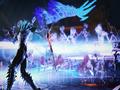
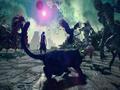
V is the final playable character, and initially, he doesn't seem like a good fit for the series. He can't actually attack directly; he has a bird deliver projectile attacks and a panther perform melee strikes while a large stone behemoth arrives when V activates his devil trigger. The only attack that V can actually do is deliver the final blow to fallen enemies, so you'd think that all he needs to do is stand back and warp to an enemy when necessary. Playing as him, however, reveals that he still needs to actively dodge foes. Since his familiars can get knocked out for a short period of time, he either needs to become aware of his surroundings so he doesn't get hurt or take a chance and stay near his creatures to ensure they're always regenerating health. Once you get acquainted with him, you'll be busting out S rank performances with ease. It doesn't take long before he becomes a nice change from the more involved hacking, shooting and juggling of both Nero and Dante.
All three protagonists contribute to DMC5's reputation of fast action with a heavy melee and combo emphasis. The controls tend to punish button-mashers, as almost every one of the big moves and combos either requires precise button presses of the same attack, a combination of using the shoulder buttons with both analog directional tilts and button presses, or a mix of the two. There's real mastery needed to pull off something stylish with the default controls, and things don't get any easier when you realize that enemies can block your moves and you can sometimes parry attacks. For those lacking finger dexterity, there is the option to have the game simplify the controls a tad to get the big combos and moves going. This is a much easier way to get S ranks and above, but you get penalized for using this by having your final score cut by one-fifth. Also, the simplification harms Dante, as the game automatically starts changing weapons for you during combat, often leaving you bewildered about why the weapons are changing if you didn't realize this beforehand.
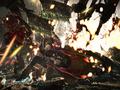
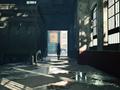

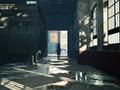

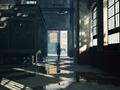
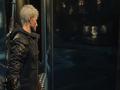
No matter which control style you use, the level design makes good use of all of those combat mechanics. Each of the arenas you encounter is enough space for you to bust out every move without feeling too crowded or having the camera get stuck in awkward places. The pacing between fighting portions and exploration portions is consistent, and it never feels like you're lingering on one part for too long. The game's levels are linear in nature, but they uphold the tradition of the older titles by having tons of little places where you'll be richly rewarded with orbs if you can find a way to reach them. Those bits, along with excellent boss fights overall, are important since the game is quite lengthy, clocking in close to double-digit playthrough hours spread over 20 levels.
When it comes to the DLC that's now built into the game, most of it is minor. You get new costumes for some of the main characters and the supporting cast for cut scenes. There are a few silly-looking arms for Nero to use. You can also splice in some songs from the soundtracks of the previous games. The extra difficulty level is great for series veterans who felt the main game was too easy, and the Bloody Palace is also a treat for those who love the combat but don't want to replay old levels to get that fix.
The main thing that players will be excited about is the ability to play as Vergil. He mostly plays the same as before, where he has access to different weapons that consist of two different sword styles and weights to a pure melee style with demonic gloves and boots. He's different from everyone else in that he needs to play with precision. While you won't get penalized for missing strikes, you get more benefits if you ensure that every attack that you unleash counts toward an enemy hit. That helps build up a meter that either lets you unleash your own Devil Trigger or produces a clone that mimics your moves. You still have some projectile attacks which work in a pinch, but you can also detach V from yourself to produce what is essentially a screen-clearing move for every fight except for bosses. Playing as Vergil in previous games has always been something special, and that charm isn't lost in this incarnation.
The only disappointing thing is that there's no separate campaign for Vergil to go through. You get a different opening cut scene that ties in with a scene in the campaign where Nero lost his arm, but that's it. You replay the main game but without any of the cut scenes present, making the jaunt a hair faster. It's sad that we don't get any extra story from the experience, but the thrill of playing as Vergil will be good enough for many players, especially since you play through every stage with him as opposed to having to split your time between three protagonists in specific stages.

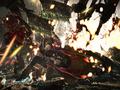
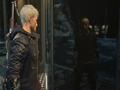
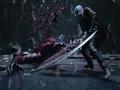
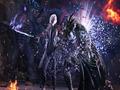
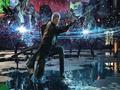
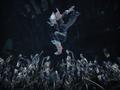
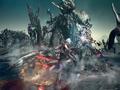
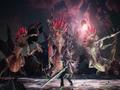
The graphics are probably the biggest thing that people are wondering about with this port, and the good news is that the compromises are minimal at best. Those compromises include the omission of the ray tracing mode and the 120fps mode seen in the PS5 version, but those aren't a big deal since the ray tracing mode forced the game to run at around 30fps, a frame rate that doesn't suit the game's style. The high frame rate mode actually fluctuated wildly to where it didn't feel right. The game also uses DLSS, but you can only tell that the technology is in place when you look at things like hair tips and other detailed items that start to fizzle, but they aren't prevalent enough to notice unless you're explicitly looking for them and trying to do side-by-side comparisons with other platforms. Beyond those things, the game holds onto a solid locked 60fps, which is paramount for a fast action title like DMC5. It does so without losing any of the visual flair of the original, so the abundance of particle effects and the excellent standard lighting are still intact and still look gorgeous. This holds true whether you're playing in docked or portable mode, making this one of the best-looking games on the system, despite the original title's age.
Similar to the graphics, the sound has lost nothing on the move to Nintendo's console. The voice acting is excellent all around, as many of the original voice actors have returned to reprise their roles. The new ones mesh rather well with the original cast, but there is also a Japanese vocal track for those who prefer it. The soundtrack is also very nice, with the interesting twist of having each character's own battle themes play whenever they fight. The transition between battle theme and level music is well done, as it doesn't feel jarring no matter how many times you move in and out of combat. The blend of rocking themes with more moody environmental music fits perfectly.
Devil May Cry 5: Devil Hunter Edition may not be a definitive port of the game, but few players would bother complaining about what's missing. This is still a fast and fluid action title with plenty of content and a campaign that never feels like it's dragging along. Most importantly, this is a port that looks just as good as its more powerful console brethren without any performance drops. Capcom has already proven in the Switch 2's first year that it can be trusted to bring out solid ports of its games with minimal compromise, and DMC5 keeps that streak going.
Score: 9.0/10
More articles about Devil May Cry 5