

 R-Type Tactics I • II Cosmos combines the side-scrolling shoot 'em up action the series is known for with tactical turn-based strategy for a unique R-Type experience!
There's always something fascinating about a franchise stepping outside its original genre. When developers take a series' core identity and explore it beyond the obvious, they often end up highlighting exactly what makes it special in the first place. R-Type is one of the most iconic side-scrolling shoot-'em-up franchises ever created, with a legacy that spans decades. That makes its transformation into a tactical RPG an unusual choice on paper, but R-Type Tactics I & II Cosmos is a collection of the two original PSP titles, and it proves that a series can successfully branch into a different genre while still feeling true to itself.
R-Type Tactics I & II Cosmos takes place in the sprawling sci-fi universe of R-Type, where humanity is locked in a desperate war against the mysterious Bydo Empire. These biomechanical horrors absorb, mutate, and corrupt everything they encounter, threatening to overwhelm human civilization. Players assume the role of a custom-created admiral tasked with commanding the fleets fighting against the invasion, leading a campaign to uncover and eliminate the source of the Bydo threat before humanity is wiped out. The collection covers two major conflicts in the series' timeline. The first chronicles the initial Bydo invasion and humanity's struggle for survival. The second follows Operation Bitter Chocolate, exploring the aftermath of that war as humanity descends into a civil conflict over the use of Bydo-derived Force weapons. As factions clash over whether relying on this technology is necessary or dangerously corrupting, the story adds a layer of political tension that questions whether humanity is slowly becoming the very thing it seeks to destroy.
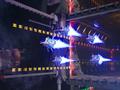
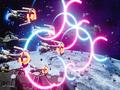
The story in R-Type Tactics is particularly effective because of how understated it is. Rather than relying on dramatic cut scenes or lengthy exposition, it uses dry mission briefings and matter-of-fact reports to gradually build its world and themes. The updates from your custom admiral are often perfunctory in a surprisingly evocative way, painting a picture of a war fought against impossible odds and, eventually, the quiet brutality of human-on-human conflict. It isn't an especially complex narrative, but it excels at creating atmosphere. That sense of mood becomes even stronger in R-Type Tactics II, which introduces a simple yet engaging branching storyline where player decisions can influence how events unfold. While the story is rarely the primary reason to play, it does an excellent job of establishing the tone and stakes that make the tactical battles feel meaningful. R-Type Tactics I also features a late-game twist that not only unlocks an entirely new campaign but also introduces one of the most strikingly inventive concepts I've encountered in a strategy game.
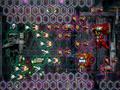
R-Type Tactics unfolds on a two-dimensional hex-grid battlefield, a design choice that mirrors the side-scrolling perspective of the shoot-'em-up originals while adapting it to a turn-based strategy format. Players deploy and maneuver units across the map, taking turns with the enemy as both sides vie for control of the battlefield. Beyond the opening missions, a fog-of-war system becomes a key part of the experience, requiring you to establish visual contact before you can effectively engage hostile forces. Combined with familiar tactical elements like zones of control, this creates a steady emphasis on positioning and reconnaissance. Most missions revolve around destroying the enemy flagship while protecting your own, but there are additional layers to consider. Resources can be mined and spent to construct new units, theoretically giving players more strategic flexibility. In practice, however, the crafting system feels somewhat underdeveloped. While the game provides opportunities to grind for materials, the mechanic is never as engaging or impactful as the rest of the tactical framework.
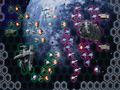
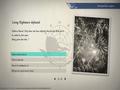
One of R-Type Tactics' greatest strengths is its strategic variety. Nearly every unit, whether human or Bydo, has a distinct role and specific mechanic. Even the first flagship embodies this philosophy. It's an outdated transport ship that the game describes as obsolete and ineffective in combat, but it can deploy a decoy that draws enemy fire and self-destructs for extra damage. That creativity extends across the entire roster. Some ships can transform, others can mimic enemy vessels, and some can slip between dimensions. New units regularly introduce mechanics that change how you approach battles, rewarding experimentation and making fleet composition just as important as battlefield tactics.
Another standout mechanic is the inclusion of the R-Type series' iconic Forces. These captured Bydo organisms have been converted into powerful weapons that can be equipped to compatible fighters. In R-Type Tactics, Forces function as independent units that can either operate on their own or attach to the front or rear of certain ships during battle to unlock stronger attacks and new combat options. The ability to switch between fielding two weaker units or combining them into a single, more powerful one adds a layer of flexibility to combat, especially since Forces are generally more durable than the ships carrying them, even if they aren't indestructible.
A major part of combat revolves around managing Charge weapons. Some of the most devastating attacks in the game require several turns of charging before they can be fired, but the payoff is often enormous, with the ability to hit multiple hexes and deal massive damage. The catch is that taking damage while charging causes all accumulated Charge to be lost. Because enemies operate under the same rules, this creates a constant strategic tension. Do you sacrifice a disposable unit to disrupt an enemy's Charge attack before it fires? Do you push aggressively to prevent opponents from charging in the first place? A single mistake can be devastating, and an overlooked enemy Charge attack can unravel an otherwise perfect plan. On the other hand, a well-timed Charge weapon of your own can completely turn the tide of a battle.
Oddly enough, this does a great job of making the game feel like R-Type while being fundamentally an entirely different genre. Strategy is incredibly important, and while you can "level up" your various squadrons and get new gear, it's not really possible to end up in a situation where you can power through. You want to consider exactly how you're going to fight and which tools can best solve the problems you're facing. The nuclear-equipped Balmung missiles are top grade stuff, but are they worth having to constantly babysit and reload the bomber units equipped with them? Is it better to play it safe or venture into enemy territory?

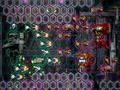
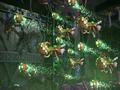
To some degree, the gameplay does perhaps over-emphasize playing it safe. Due to the way the charge mechanic works, it's frequently better to force enemies to come to you than to go to them, which can lead to some missions feeling slightly repetitive. The game tries to balance this by putting special collectible items behind enemy lines that are necessary for higher-end upgrades, but since you don't even need to finish a mission to keep those, it only goes so far. Still, the gameplay is fun enough that it's a minor problem at best.
R-Type Tactics I & II Cosmos has an absurd amount of content. It includes both original R-Type Tactics games alongside the new COSMOS expansion, which adds extra missions and gameplay. You can easily get over a hundred hours out of it, making it one of the best values in gaming if the style clicks with you. The sheer variety and depth on offer keep it engaging throughout. With its huge roster of units, layered mechanics, and extensive campaign content, there's always something new to experiment with. If the gameplay suits your tastes, it's an exceptionally rich strategy package with a huge amount to explore.
R-Type Tactics is simply very dry. The core gameplay is very fun, but the presentation leaves a lot to be desired. Despite having combat animations available, none of those animations carry any weight or impact. The game doesn't remotely capture the frantic feel of the side-scrolling games, and at times, it feels more akin to watching a board game play out.
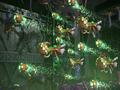
It doesn't help that it's honestly not a very graphically impressive game. Most of the time, you'll be watching very simple (and frequently similar looking) models moving across a fairly basic 2D space. There are canned animations that play for most actions, but they're not very impressive to look at. The games began as a PSP game, and it shows most in the presentation. The games do have voice acting for the commander's logs, which is a nice touch, and the soundtrack is solid enough to be memorable, but it's very much a gussied-up PSP title.
Overall, assuming you don't mind the relatively low production values, R-Type Tactics I & II Cosmos is an excellent strategy RPG experience. The core gameplay is fun, the story is atmospheric and interesting, and the sheer amount of content means you're hard-pressed to find a better value for your dollar. You don't even need to be familiar with R-Type to enjoy the experience, but obviously, a familiarity with the franchise adds that little extra zing.
Score: 8.0/10


More articles about R-Type Tactics I • II Cosmos